
[ad_1]
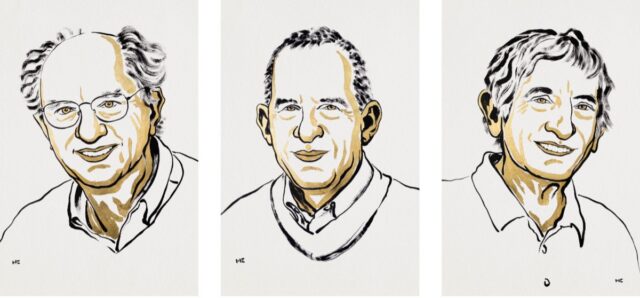
(l-r): John Clarke, Michel H. Devoret, and John M. Martinis.
Credit:
Niklas Elmehed/Nobel Prize Outreach
From subatomic to the macroscale
Clarke, Devoret, and Martinis were the first to demonstrate that quantum effects, such as quantum tunneling and energy quantization, can operate on macroscopic scales, not just one particle at a time.
After earning his PhD from University of Cambridge, Clarke came to the University of California, Berkeley, as a postdoc, eventually joining the faculty in 1969. By the mid-1980s, Devoret and Martinis had joined Clarke’s lab as a postdoc and graduate student, respectively. The trio decided to look for evidence of macroscopic quantum tunneling using a specialized circuit called a Josephson junction—a macroscopic device that takes advantage of a tunneling effect that is now widely used in quantum computing, quantum sensing, and cryptography.
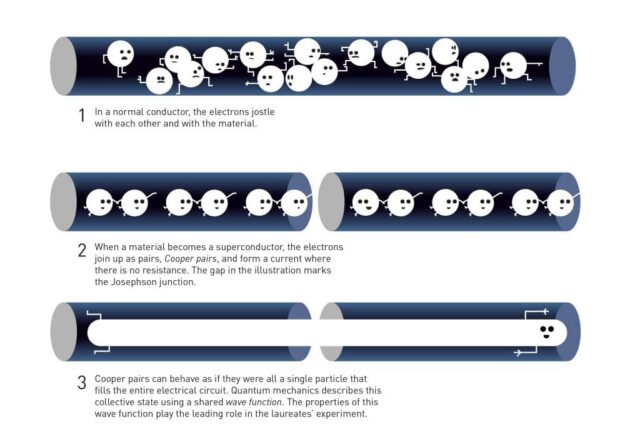
A Josephson junction—named after British physicist Brian Josephson, who won the 1973 Nobel Prize in physics—is basically two semiconductor pieces separated by an insulating barrier. Despite this small gap between two conductors, electrons can still tunnel through the insulator and create a current. That occurs at sufficiently low temperatures, when the junction becomes superconducting as electrons form so-called “Cooper pairs.”
The team built an electrical circuit-based oscillator on a microchip measuring about one centimeter in size—essentially a quantum version of the classic pendulum. Their biggest challenge was figuring out how to reduce the noise in their experimental apparatus. For their experiments, they first fed a weak current into the junction and measured the voltage—initially zero. Then they increased the current and measured how long it took for the system to tunnel out of its enclosed state to produce a voltage.
Credit:
Johan Jarnestad/The Royal Swedish Academy of Sciences
They took many measurements and found that the average current increased as the device’s temperature falls, as expected. But at some point, the temperature got so low that the device became superconducting and the average current became independent of the device’s temperature—a telltale signature of macroscopic quantum tunneling.
[ad_2]
Source link


