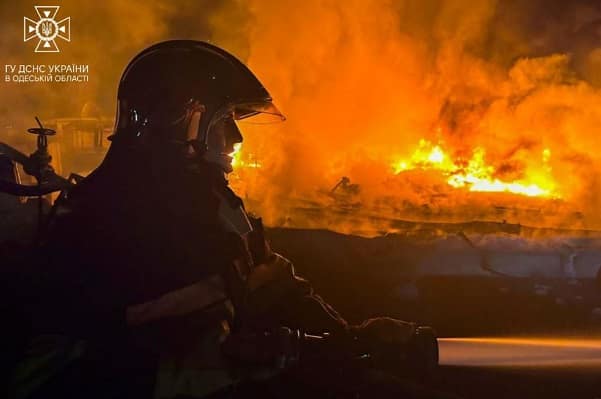
A total of 111 firefighters have been killed and more than 400 injured since Russia launched its illegal invasion in February 2022
When people think of Ukraine’s defence, they picture soldiers in trenches, drone operators hunched over screens, or artillery crews working through the night.
What they rarely see are the unarmed men and women who run towards danger long after the shooting has stopped.
I was present during The Sun’s interview with members of Ukraine’s Home Guard, volunteers whose job is not to fight, but to save lives in the aftermath of Russian attacks.
What I witnessed was not heroics for the camera, but quiet professionalism carried out in some of the most dangerous environments in Europe.
These are the people who arrive first at bombed apartment blocks, shattered schools, and burning hospitals. They dig through rubble with their hands, pull survivors from collapsed stairwells, and coordinate evacuations under the constant threat of secondary strikes. They do all of this unarmed, often with minimal protective equipment, and increasingly while being deliberately targeted by Russia.
Not Soldiers — but essential to survival
Ukraine’s Home Guard and emergency volunteer units are not frontline combat troops. Many are ordinary civilians: builders, electricians, teachers, mechanics. Since 2022, they have trained themselves to respond to missile and drone strikes, structural collapses, fires, and mass-casualty events.
Their role is deceptively simple: save who can be saved.
In practice, it is brutal. Russian attacks rarely end with a single strike. “Double taps”, a second missile or drone launched minutes after the first, are a well-documented Russian tactic. The purpose is clear: hit rescuers.
During the interview, volunteers described working against the clock, knowing that every minute spent searching rubble increases the risk of another explosion. Yet they go anyway. Because if they don’t, no one else can reach those trapped beneath concrete and twisted steel.
I have operated in conflict zones. I have been on the receiving end of Russian fire. Watching these volunteers work without weapons, without armour, and without any illusion of safety was one of the starkest reminders of what modern war looks like when civilians are deliberately placed in the crosshairs.
Russia knows who they are
What has changed in recent months is intent.
Russia is no longer merely indifferent to civilian rescuers, it is actively targeting them.
Emergency vehicles have been struck. Clearly marked responders have been wounded and killed. Areas are hit again precisely when rescue efforts begin. This is not accidental. It mirrors Russian behaviour in Syria, where first responders, including the White Helmets, were systematically hunted to break civilian resilience.
The message is unmistakable: helping the wounded is now treated as a hostile act.
These Home Guard volunteers understand this reality. They spoke openly about friends who have been injured or killed while pulling strangers from rubble. They know that wearing a high-visibility vest or driving a marked vehicle no longer offers protection. Yet they still deploy.
Because without them, civilian death tolls would be exponentially higher.
(Original reporting referenced: https://www.thesun.co.uk/news/37608184/ukraine-home-guard-unarmed-heroes-save-lives/)
Unsung, underfunded, unbroken
Unlike professional emergency services in Western countries, many of these volunteers operate with limited funding. Equipment is often donated. Vehicles are repaired repeatedly rather than replaced. Training is conducted on the job, under fire.
And yet, the stories I listened to were nothing short of remarkable.
Teams worked methodically — logging locations, checking voids in collapsed structures, managing crowds, and liaising with medics. This is not chaos. It is resilience built under pressure.
They do not seek recognition. Most do not even consider themselves heroes. When asked why they keep doing it, the answers were disarmingly simple:
“Because someone has to.”
“Because it might be my family next time.”
“Because this is our home.”
Why this matters beyond Ukraine
These volunteers represent something Russia fundamentally misunderstands: civilian resilience cannot be bombed into submission.
Every time a Home Guard team pulls a survivor from rubble, it denies the Kremlin its intended psychological victory. Every life saved is an act of resistance.
But resilience has limits. Targeting unarmed responders is a war crime, and it must be treated as such. Their protection, resourcing, and recognition are not optional — they are essential.
Ukraine does not only need weapons at the front. It needs sustained support for those who hold the rear together when the missiles fall.
Credit where it’s due
The original interview that brought these volunteers into the public eye was conducted by The Sun, and credit is due for highlighting a story that often goes untold. I was present during that reporting, witnessing events unfold in real time, in real danger, alongside people who deserve to be seen.
They are not soldiers.
They are not armed.
But without them, many more Ukrainians would be dead.
These are Ukraine’s unsung heroes — and Russia knows it.


