[ad_1]
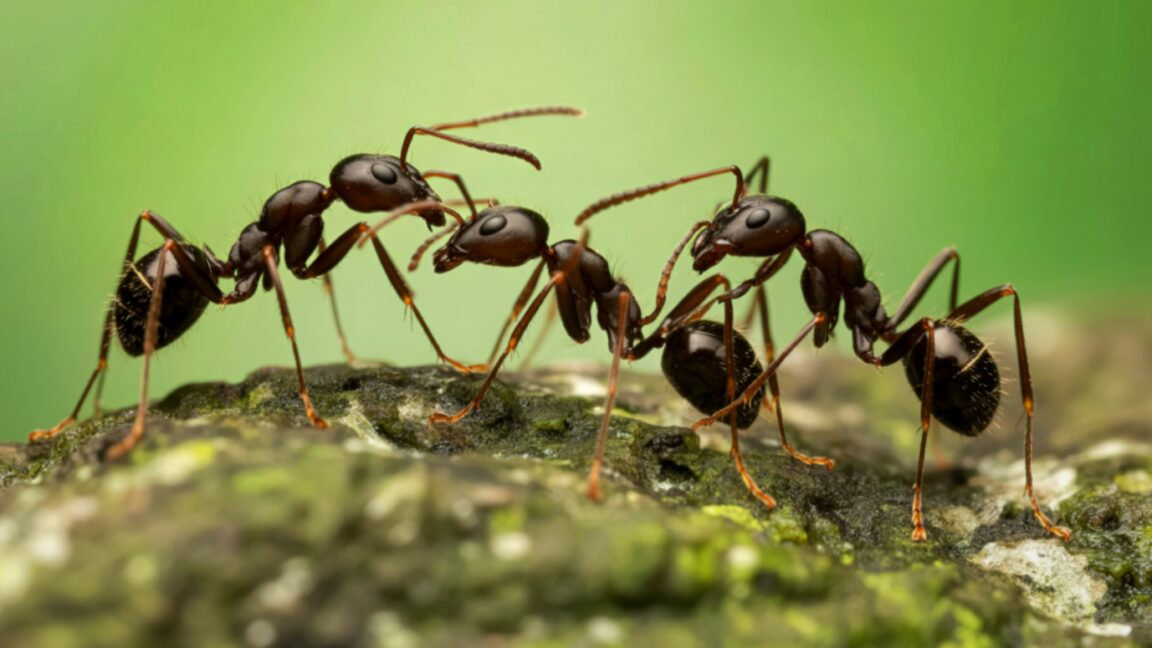
“Ants reduce per-worker investment in one of the most nutritionally expensive tissues for the good of the collective,” Matte explains. “They’re shifting from self-investment toward a distributed workforce.”
Power of the collective
The researchers think the pattern they observed in ants reflects a more universal trend in the evolution of societal complexity. The transition from solitary life to complex societies echoes the transition from single-celled organisms to multicellular ones.
In a single-celled organism, a cell must be a “jack-of-all-trades,” performing every function necessary for survival. In a multicellular animal, however, individual cells often become simpler and more specialized, relying on the collective for protection and resources.
“It’s a pattern that echoes the evolution of multicellularity, where cooperative units can be individually simpler than a solitary cell, yet collectively capable of far greater complexity,” says Matte. Still, the question of whether underinvesting in individuals to boost the collective makes sense for creatures other than ants remains open, and it most likely isn’t as much about nutritional economics as it is about sex.
Expendable servants
The study focused on ants that already have a reproductive division of labor, one where workers do not reproduce. This social structure is likely the key prerequisite for the cheap worker strategy. For the team, this is the reason we haven’t, at least so far, found similar evolutionary patterns in more complex social organisms like wolves, which live in packs—or humans with their amazingly complex societies. Wolves and people are both social, but maintain a high degree of individual self-interest regarding reproduction. Ant workers could be made expendable because they don’t pass their own genes—they are essentially extensions of the queen’s reproductive strategy.
Before looking for signs of ant-like approaches to quality versus quantity dilemmas in other species, the team wants to take an even closer look at ants. Economo, Matte, and their colleagues seek to expand their analysis to other ant tissues, such as the nervous system and muscles, to see if the cheapening of individuals extends beyond the exoskeleton. They are also looking at ant genomes to see what genetic innovations allowed for the shift from quality to quantity. “We still need a lot of work to understand ants’ evolution,” Matte says.
Science Advances. 2025. DOI: 10.1126/sciadv.adx8068
[ad_2]
Source link


