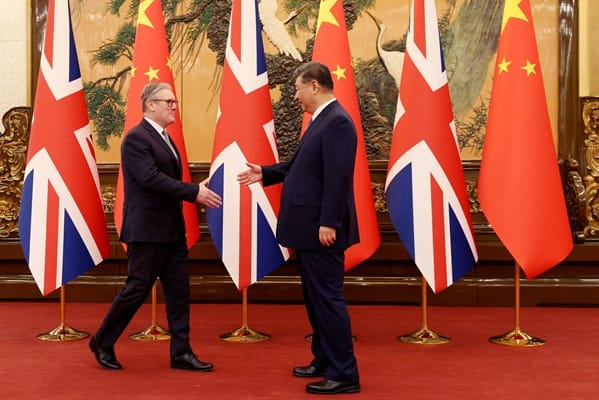
Keir Starmer’s trip to Beijing marks the first visit by a UK prime minister in eight years. The tone was warm, the choreography precise, and the ambition clear.
The Prime Minister wants a more “sophisticated” relationship with China at a moment when global alliances are shifting and Washington is keeping partners guessing on trade and foreign policy.
For UK business leaders, speeches matter less than outcomes. Companies don’t run on atmospherics, they trade in rules, risks, and returns.
Starmer’s visit signals that London wants commercial engagement again. Fine. The real question is what UK firms actually get from this reset beyond headlines and handshake photos.
First, predictability.
British firms can handle competition, what they can’t handle moving goalposts. China remains a vast market for finance, manufacturing, education, and consumer brands, yet access often depends on political mood, shifting sector priorities, and opaque approvals.
A genuine reset would bring clearer licensing processes, fewer arbitrary delays, and transparency when regulations change.
Without that, boards will keep treating China as an opportunistic market rather than a pillar of long-term growth. Companies invest when they believe the rules will still exist in five years.
Second, clarity on risk.
A modern China policy can’t be blind enthusiasm, and it can’t be constant alarm. Starmer talks about engagement alongside vigilance on security, which is politically neat, but which also commercially vague.
UK companies need a clearer sense of where the boundaries sit and where government wants them to lean in. Tech, data, critical infrastructure, and defence-linked sectors obviously need guardrails. Consumer goods, services, and non-sensitive manufacturing should be encouraged. Firms can manage risk when the framework is explicit.
Third, consistency on capital.
Britain still wants foreign capital; and China still wants to invest, partner, and buy assets. Businesses and investors need consistency.
A stable screening regime that separates genuine national security concerns from ordinary commercial activity would reduce uncertainty and lower financing costs.
Sudden policy shifts, politicised approvals, and shifting thresholds deter long-term projects. As we know from experience, investment will simply go elsewhere if the rules feel improvised.
Starmer’s trip touched on practical trade irritants such as whisky tariffs and visas. Those are useful signals. The same logic should apply to investment. Predictable decisions matter more than warm statements.
Fourth, support for exporters.
China remains one of the UK’s largest trading partners, with annual bilateral trade around £100 billion. Trade missions and summit announcements look impressive. Businesses care about execution.
Fast-moving export finance, dispute resolution that actually resolves disputes, and targeted support for sectors with real demand would help firms convert interest into revenue. Governments celebrate deals. Companies need help delivering them.
The broader context is uncomfortable but unavoidable. Global trade is fragmenting. Tariffs, industrial policy, and security concerns are reshaping supply chains. China remains too large to ignore and too complex to treat as a simple growth story. Of course, British domestic policy coherence matters too. Mixed messages across departments increase uncertainty and raise capital costs. Predictable policy lowers risk premiums. Volatile policy raises them.
China sees Starmer’s visit as validation; the UK sees opportunity; and both sides see leverage. Business leaders should see upside and risk in equal measure. It’s my view that the trip is a diplomatic reset, not a commercial revolution.
Political theatre has its place, but firms and markets care about ‘plumbing’. The UK–China relationship will remain transactional, uneven, and occasionally tense. Businesses can operate in that environment, but only if policy is stable and rules are clear.
It can be expected that companies in Britain will be treating the visit as an opening bid, not a turning point. Let’s hope that, moving forward, Beijing and London will provide not only headlines and photoshoots, but structures offering predictability, clarity, consistency and support.


