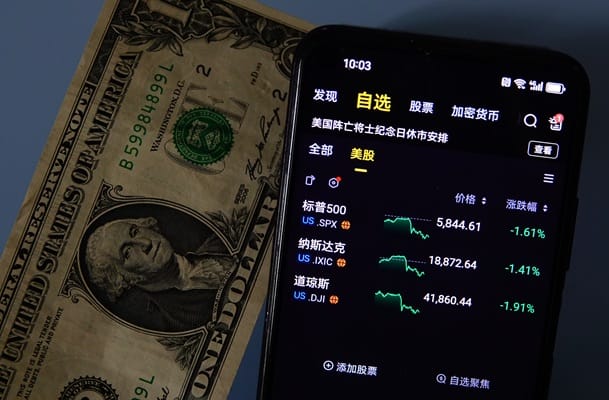
In light of the recent shifts in currency markets, I believe that the weakness of the US dollar is no longer a secondary factor in equity pricing, but has become a pivotal variable reshaping expectations for the S&P 500 index and the broader trajectory of US equities.
From my perspective, what we are currently witnessing is a delicate transitional phase, where currency movements intersect with monetary policy and the evolving nature of the US economy itself.
This makes any forward-looking assessment increasingly dependent on a deeper understanding of the relationship between the dollar and the various sectors within the index.
Building on the analysis from the New York Fed, which confirms that a weaker dollar is reshaping sectoral movements, I view this perspective as a reflection of an advanced reality that investors can no longer afford to ignore.
The dollar is no longer merely a pricing tool or a safe haven; it has become a direct transmission channel for both economic shocks and investment opportunities.
As dollar volatility returns to the forefront of investor concerns, a negative feedback loop strengthens, influencing hedging behaviour and the reallocation of capital across sectors, with direct implications for the performance of the S&P 500.
From my standpoint, US dollar weakness provides structural support to sectors with high international exposure, most notably technology, digital services, communications, and global healthcare. These sectors benefit not only from improved global competitiveness, but also from the revaluation of future earnings when foreign revenues are translated back into dollars.
Accordingly, I expect these sectors to maintain their relative outperformance within the index, even in the event of a potential economic slowdown, as long as the dollar remains weak or volatile.
By contrast, I believe that traditional sectors that were historically more sensitive to dollar strength, such as industrials and energy, now face a more complex relationship with the US currency. The structural shift highlighted by Bob Savage since the late 1990s—namely, the transition of US exports from industrial goods to technology-based services—has fundamentally altered the nature of this relationship. As a result, dollar weakness is no longer an absolute guarantee of strong performance for the industrial sector. Instead, performance has become increasingly linked to the extent to which companies are integrated into global value chains and their ability to capture genuine external demand, rather than relying solely on currency differentials.
At the level of capital flows, I believe that a weaker dollar opens the door to strategic shifts in asset allocation. Global investors are reassessing the relative attractiveness of US equities versus other markets. In my view, the S&P 500 will remain a preferred destination, but not under the same logic as before. Today’s appeal is no longer based solely on the strength of the US economy, but rather on the resilience of its sectors and their ability to adapt to a weaker currency environment combined with more complex inflation dynamics. This implies that selectivity will become the decisive factor, rather than broad-based exposure to the index as a whole.
From a market outlook perspective, I expect the S&P 500 to continue its upward trend over the medium term, but at a slower and more volatile pace. Dollar weakness may provide valuation and sentiment support for equities, but this support is likely to be offset by pressures stemming from tighter financial conditions, slower growth, and changing US consumer behaviour. Consequently, I anticipate a market characterized by sector rotation, where capital flows shift between sectors that benefit from dollar weakness and those capable of protecting profit margins in a lower-growth environment.
As for US equities more broadly, I believe the next phase will reward companies with global operating models, stable cash flows, and strong pricing power. In this context, dollar weakness is not merely a cyclical tailwind, but a genuine test of underlying business strength. Companies driven by innovation and cross-border services are likely to be better positioned, while firms with a domestic focus or high-cost structures may face greater challenges, even if they theoretically benefit from a weaker currency environment.
In conclusion, I believe that the relationship between the US dollar and the S&P 500 has entered a more mature and complex phase. Dollar weakness is indeed reshaping sector dynamics, but it does not guarantee broad or effortless gains. My outlook favours continued positive performance for US equities, supported by economic resilience and structural transformation, but within an environment that requires careful monitoring of currency trends, inflation, and capital flows. Investors who understand this equation will be best positioned to seize opportunities, while those who overlook the role of the dollar risk falling out of sync with the market’s new rhythm.


