[ad_1]
Because of this, NASA engineers accept that a small amount of hydrogen will escape seals in the fueling line. Agency officials said in 2022 that the safe limit was a 4 percent concentration of hydrogen gas in the housing around the fueling connector. Hydrogen levels exceeded NASA’s safety limit multiple times during the practice countdown that ran from Monday into early Tuesday.
Credit:
NASA
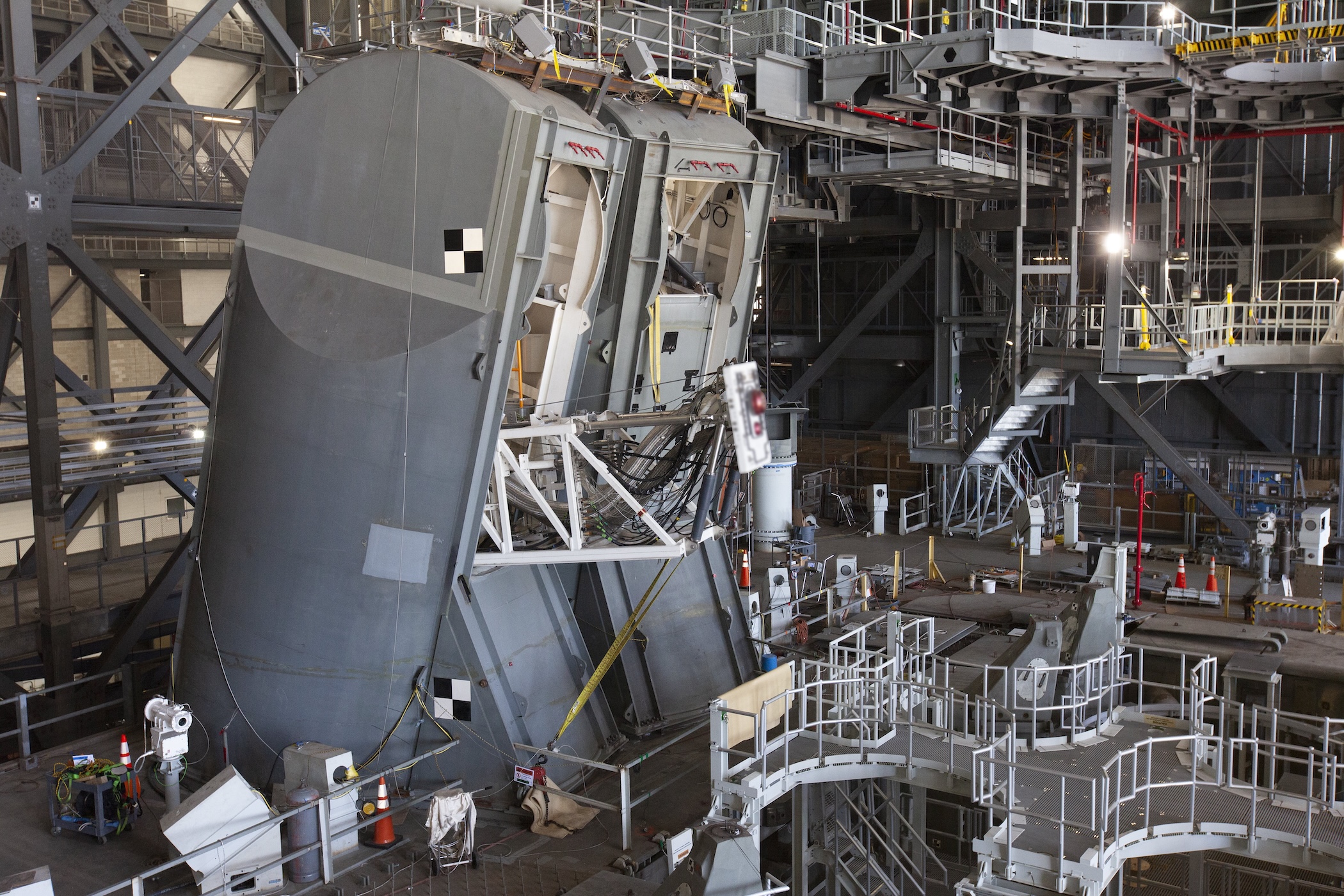
This photo, taken in 2019, shows the liquid hydrogen Tail Service Mast Umbilical undergoing tests inside the Vehicle Assembly Building. The connector plate is visible at the end of the arm in the center of the photo.
Credit:
NASA
“ Attempts to resolve the issue involved stopping the flow of liquid hydrogen into the core stage, allowing the interface to warm up for the seals to reseat, and adjusting the flow of the propellant,” NASA said in a statement.
NASA appeared to get past the problem Monday evening and fully loaded the 322-foot-tall (98-meter) rocket with more than 750,000 gallons of propellant.
With fueling complete, managers sent a closeout crew to the launch pad around 6 pm EST (23:00 UTC) to close the hatch to the Orion spacecraft sitting atop the SLS rocket. The closeout team will help the Artemis II astronauts into the Orion capsule on launch day, but the crew was not part of the practice countdown Monday night.
The closeout crew took longer than anticipated to close and secure the hatch to the Orion spacecraft. A valve associated with Orion’s hatch pressurization inadvertently vented, according to NASA, requiring the closeout crew to retorque the valve. The launch team dealt with several other glitches, including audio dropouts on ground communication loops and camera problems believed to be caused by recent cold weather in Central Florida.
Finally, with the closeout crew a safe distance from the rocket, the launch team gave approval to begin the final 10 minutes of the countdown shortly after midnight Tuesday. The objective was to stop the countdown clock 33 seconds prior to launch, about the same time the rocket would take control of the countdown during a real launch attempt.
[ad_2]
Source link


