AI-generated images now headline billboards, fill product catalogues, and slip into everyday slide decks—a leap from party trick to mainstream business tool.
UK teams want specifics: Which API delivers brand-grade polish, how fast can it crank thousands of variants, and what does that agility cost when finance reviews the bill?
This guide answers by benchmarking five platforms—Leonardo, OpenAI DALL·E 3, Stability AI SDXL, Adobe Firefly, and Prodia—against quality, cost, speed, and dev-friendliness so you can pick the right stack.
Our evaluation criteria and ranking method
Before we crowned any winners, we first defined what “best” means for a UK business that ships images at scale. We spoke with product managers, reviewed API docs, and measured real response times. Four factors topped the list.
First comes image quality. If the picture looks off, nothing else matters. We judged sharpness, prompt accuracy, and those tricky edge cases such as hands, sign text, and fine product details.
Next is cost efficiency. Whether credits, tokens, or GPU-seconds, we converted every billing model to an estimated price per 512-pixel image, then modelled a batch of 10,000 assets to see who stays affordable.
Speed ranks third. Your workflow stalls if each call crawls, so we timed average latency from request to finished JPEG and looked for figures a human user would call “instant.”
Finally, integration and features. We checked how quickly a developer can get “hello, world” running, plus extras like image-to-image, upscaling, or private fine-tuning.
To keep the maths honest, we weighted the quartet 40, 25, 20, and 15 percent respectively. The weighting favours visual fidelity, but still rewards a bargain or a rapid turnaround. Each platform earned a numeric score in every bucket, and the composite score determined the ranking you’ll see in the next pages.
Simple, transparent, and repeatable. The results proved surprisingly decisive.
At-a-glance comparison
You now know how we score each service. Before we begin the individual reviews, let’s step back and see how the five contenders compare side by side.
The table below distils the metrics that shape daily decisions: price per image, typical latency, headline features, and the jobs each platform handles best. Use it as a quick reference while you read the deeper dives that follow.
| Platform | API pricing (512 px image) | Typical speed | Stand-out features | Best suited to |
| Leonardo AI | Pay-as-you-go credits ≈ £0.01–£0.02; £5 free starter pot | 1–3 s | Fine-tuning, image-to-image, WYSIWYG → API workflow | Game art, branded styles |
| OpenAI DALL·E 3 | Token model ≈ £0.03–£0.09 per image | 10–20 s | High prompt fidelity, legible text, strong policy guardrails | High-end marketing visuals |
| Stability SDXL | Hosted API ≈ £0.002–£0.01; self-host nearly free | 1–5 s (sub-1 s Turbo) | Open-source model, self-hosting, rich community add-ons | Large-scale, custom pipelines |
| Adobe Firefly | Enterprise credits bundled with Creative Cloud | 5–8 s | Licensed training data, content credentials, CC integration | Brand-safe corporate workflows |
| Prodia API | From £0.008; £10 ≈ 1 k images | 0.2 s | Ultra-fast distilled model, simple REST, batch-friendly | Real-time or bulk automation |
Keep this sheet handy. Next, we’ll start the deep dive with the tool that topped our scoreboard.
Leonardo AI: the style-first workhorse
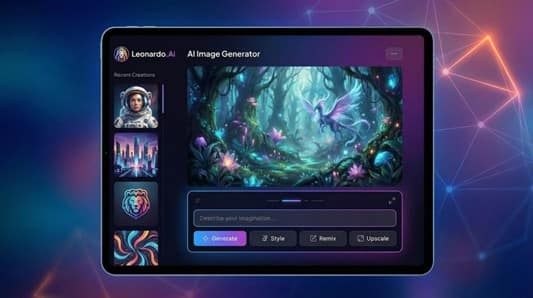
Leonardo AI creative suite and image generation workspace screenshot
Leonardo tops our chart because it strikes a rare balance: designer-friendly visuals, developer-friendly code, and pricing that lets you rest easy. Think of it as a shared canvas where creatives sketch ideas in the web UI, then hand engineers the exact API call that reproduces those pixels, byte for byte.
Quality comes first. Leonardo fine-tunes Stable Diffusion under proprietary “Select” and “Lucid” presets, so prompts land with fewer guess-and-check loops—a workflow you can preview inside Leonardo’s creative suite, where those models sit alongside AI Canvas, Image-to-Image editing, and batch upscaling in one browser workspace. Characters keep their limbs, fantasy scenes burst with colour instead of noise, and photoreal shoots stay sharp when you zoom.
Speed stays brisk. A 512-pixel image usually returns in about two seconds, quick enough for real-time previews and batch renders alike. Bump the resolution to 1,024 and the wait is roughly five seconds. Parallel requests scale smoothly, so launch campaigns never bottleneck.
Cost remains sensible. Credits start with a £5 free pot and settle near £0.01 per image once you buy in bulk. There is no subscription lock-in, and the licence is royalty-free for commercial use. Your brand owns what it generates.
Where Leonardo shines is control. Need an on-brand illustration set? Train a private model on a dozen reference images, call it from the API, and every output stays perfectly “you.” With built-in image-to-image, upscaling, and an experimental video beta, the platform grows with your ambitions.
Bottom line: if you juggle designers, developers, and deadlines, Leonardo bends to each role without bending your budget. It is the toolkit we reach for when creativity and consistency must coexist.
OpenAI DALL·E 3: premium polish for pixel-perfect briefs
When accuracy matters most, DALL·E 3 is the tool you reach for. OpenAI tamed the creative chaos of earlier models with GPT-4 reasoning, so the system reads your prompt like a copywriter, not a fortune-teller.
The payoff is excellent fidelity. Ask for “a 1960s-style tea advert featuring a lime-green teapot and serif text underneath,” and the image lands exactly as written, right down to the kerning. No other public API matches its knack for legible signage or complex multi-object layouts.
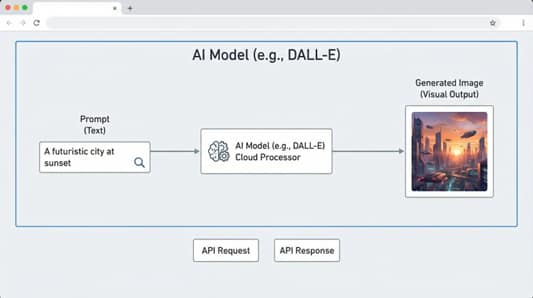
OpenAI DALL·E 3 images API documentation screenshot
That precision costs two currencies: time and money. Generation sits around 15 seconds, which feels slow if you are iterating live with a client. Pricing follows a token model: OpenAI lists the gpt-image-1 endpoint at roughly £0.03–£0.09 per 1,024-pixel image, so detailed prompts and high resolutions add up quickly. Perfect for one-off hero assets, costly for volume work.
Integration is smooth. If ChatGPT already feeds your stack, swapping in gpt-image-1 takes minutes. OpenAI’s monitoring dashboards and strict safety rails reassure compliance teams, especially in finance, health, or education where rogue content raises risk.
Bottom line: DALL·E 3 feels like the agency retainer of image APIs. It is pricey and occasionally slow, but when a brief leaves no room for error, nothing else closes the gap so consistently.
Stability AI SDXL: open-source power on your terms
Stable Diffusion changed the rules by going open source. SDXL is the sharpest version yet, and Stability AI’s hosted API supplies the muscle without DevOps headaches.
Quality is solid. Faces look human, scenes feel vibrant, and with the right prompt SDXL rivals pricier models. It can misfire on niche anatomy or dense text, but a community fine-tune often fixes the issue. Because the weights are public, you can drop in an anime checkpoint today and a photoreal one tomorrow.
Speed is the secret weapon. Turbo mode returns a 512-pixel thumbnail in under one second. Standard mode averages two to four seconds, and a self-hosted A100 can shave off even more.

Stability AI SDXL Turbo developer docs screenshot
Cost stays low. The hosted API starts around £0.002–£0.01 per mid-res render, and self-hosting pushes marginal costs down to electricity plus GPU rent. At tens of thousands of images, those pennies add up to large savings.
Flexibility seals the deal. Need image-to-image, inpainting, or private fine-tuning? Each is one POST request away. Strict data policy? Run your own instance behind a firewall and keep every pixel in-house.
Stability AI suits builders who prize control and scalability over turnkey polish. It is the multi-tool in your generative kit, ready for custom jobs.
Adobe Firefly: brand-safe images wired into Creative Cloud
Firefly targets enterprise teams. Adobe trained the model only on licensed and public-domain content, so every pixel carries a clear usage trail. Legal teams relax, and you skip the extra stock-photo licence line on the invoice.
Quality leans toward polished commercial art. Illustrations feel like they came straight from Adobe Stock, while photoreal shots land just shy of DALL·E’s best but ahead of most diffusion peers. Crucially, Firefly avoids the odd glitches that create compliance headaches.
Speed sits in the middle of the pack. Expect a five- to eight-second wait for a 1,000-pixel render. That is fast enough for batch creatives and template automation.
Pricing ties into Creative Cloud bundles. You purchase “generative credits,” then draw them down through the API. Adobe lists 100 credits at roughly £4.50, with hundreds more included in most business plans. For companies already invested in Adobe, the cost feels incremental; newcomers may see it as steep next to open-source options.
Integration is Firefly’s ace. The API plugs into Photoshop, Illustrator, Experience Manager, and your digital asset manager. Generate an image, keep the content credentials intact, and drop it into a PSD without leaving your pipeline. That end-to-end flow saves designers hours and trims version-control friction.
In short, Firefly is the sensible suit in a casual room. If your organisation prizes IP safety, governance, and smooth hand-offs between marketing and design, Adobe’s generative stack earns its keep.
Prodia API: lightning-fast images for real-time ideas
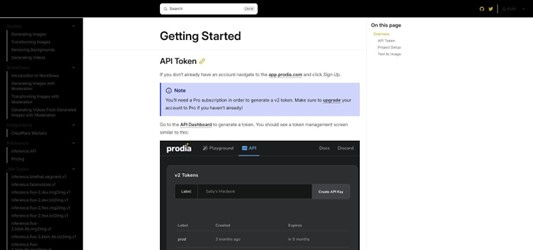
Prodia API documentation screenshot highlighting fast image generation
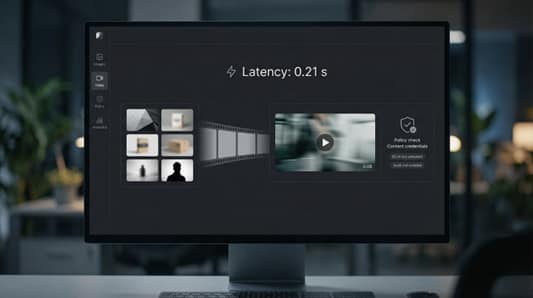
Prodia focuses on speed. Send a request and, in about 0.2 seconds, a 512-pixel image returns to your app. That near-instant response turns generative art from a background task into a live user experience.
Why so quick? Prodia distils diffusion into a compact “Flux Schnell” model that trades some photoreal nuance for raw pace. Textures and complex scenes can look softer than DALL·E or SDXL, yet for social thumbnails, in-app stickers, or rapid A/B tests it is more than sharp enough.
Costs echo the performance. Pricing starts near £10 per 1,000 images, with a free tier for prototypes. The simple REST endpoints work in batch mode, and concurrency limits are generous.
The platform stays focused. There is no ornate GUI—just text-to-image, image-to-image, and basic inpainting. That minimalism appeals to dev teams who want to embed generation rather than oversee it.
Use Prodia when milliseconds count: chat bots that draw on demand, games that let players design avatars on the fly, or marketing tools that roll out thousands of personalised hero images overnight. For those jobs, nothing else moves this fast at this price.
What’s next? Three trends shaping 2026
- Raw speed climbs further. Stability’s SDXL Turbo renders a 512-pixel frame in about 200 ms on an A100 GPU (Ars Technica). Sub-second latency opens real-time features such as live video filters or games that respond to spoken prompts.
- Images give way to video. OpenAI, Runway, and several stealth startups are racing to commercialise text-to-video. When you plan today’s stack, check that your vendor publishes a roadmap for clips, not just stills.
- Governance tightens. The EU’s AI Act and upcoming UK guidelines lean toward disclosure and licensed training data. Adobe now tags outputs with content credentials, and Stability has joined the same coalition. Choosing a model trained on cleared images could soon spell the difference between a quick launch and a legal dispute.
Stay alert to these currents. The API you adopt today should fit faster, richer, and more regulated pipelines a year from now.
https://leonardo.ai/ai-image-generator/


