[ad_1]
Poland is urging their citizens to leave Iran immediately, warning that the “possibility of a conflict is very real” amid escalating tensions over Tehran’s nuclear programme.
Prime Minister Donald Tusk issued the warning on Thursday while speaking in Zielonka, outside Warsaw.
“Please leave Iran immediately and under no circumstances travel to this country,” he said.
“I do not want to alarm anyone, but we all know what I am referring to. The possibility of a conflict is very real.”
He added that evacuation routes could close rapidly.
“In a few, a dozen, or several dozen hours, evacuation may no longer be possible.”
Tusk’s remarks come as the United States significantly strengthens its military posture in the Middle East.
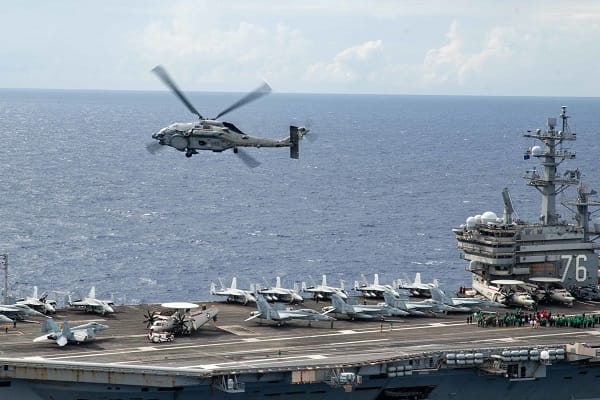
The world’s largest aircraft carrier, the USS Gerald R. Ford, is moving from the Caribbean toward the region, where it would join the USS Abraham Lincoln and its strike group.
The Abraham Lincoln and accompanying guided-missile destroyers arrived more than two weeks ago. This week, the United States Central Command released images showing F/A-18 Super Hornets operating from the carrier’s deck in the Arabian Sea.
“With a catapult launch, the Super Hornet can go from a full stop to airborne in under three seconds,” CENTCOM noted, underscoring the strike group’s rapid-response capability.
The dual-carrier presence significantly increases US air power and deterrence capacity in the region.
President Donald Trump said on Friday that he is “considering” ordering airstrikes on Iran to pressure Tehran into agreeing to a new nuclear deal.
Asked directly whether limited strikes were under review, Trump replied:
“I guess I can say I am considering that.”
He has suggested Iran faces a roughly 10-day window to reach an agreement.
“We have to make a meaningful deal, otherwise bad things happen,” he said, adding that Iran “cannot have a nuclear weapon.”
Tehran has consistently maintained that its nuclear programme is intended for civilian purposes and has not publicly accepted Washington’s proposed framework.
Intermittent negotiations have involved US representatives, including Steve Witkoff and Jared Kushner. Talks held in Geneva last week ended without a breakthrough.
The convergence of diplomatic deadlock, visible military deployments, and evacuation warnings from European governments signals growing concern that the standoff could escalate rapidly.
For now, Washington appears to be pursuing a dual-track strategy: intensified military pressure alongside continued — if fragile — negotiations.
Whether that approach produces a deal or deepens confrontation may become clear within days.
[ad_2]
Source link


