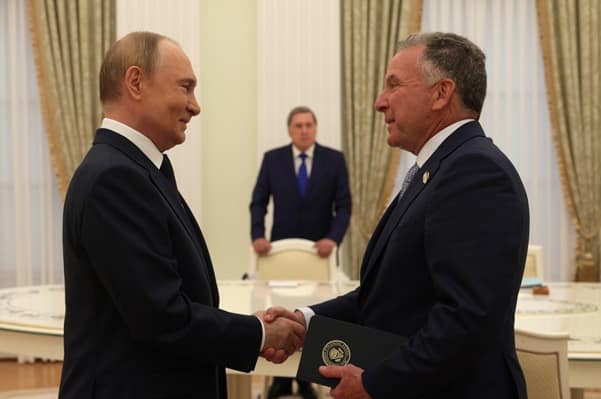
In recent weeks, responses to statements made by President Donald Trump’s special envoy Steve Witkoff on FOX News have underscored a dangerous trend: the minimisation of Russian atrocities in Ukraine under the guise of “peace talks.”
Critics argue that such rhetoric does not merely reflect naïveté, but risks whitewashing the very real harm inflicted by Moscow since its full-scale invasion in February 2022.
Witkoff, a U.S. real estate executive turned envoy with no formal diplomatic training, is being pitched against a hardened former KGB officer who has ruled Russia for more than two decades and built his career on coercion, deception, and the ruthless exploitation of power.
The imbalance is stark. Yet Witkoff drew sharp criticism for referring to aspects of the war in Ukraine as “silly” and for his upbeat characterisation of Russian President Vladimir Putin as someone who was supposedly “straight” with him.
In an interview with Lara Trump, his comments appeared to echo Kremlin talking points rather than reflect the documented brutality on the ground, a striking disconnect given that Russia continues to reject ceasefires and relentlessly bomb Ukrainian cities such as Kherson, Zaporizhzhia, and others that still bear the scars of prolonged attack.
This raises a fundamental legal and ethical question: how can any mediator hope to secure lasting peace if they fail to properly recognise the magnitude of the crimes committed, especially when they have never even set foot in Ukraine?
This is not a minor border dispute; it is a continent-shaking war that has displaced a population roughly the size of a European country. As of January 2026, around 3.7 million people remain internally displaced inside Ukraine, while some 5.35 million have sought refuge across Europe.
The UN Human Rights Monitoring Mission in Ukraine reports that since February 2022 more than 15,000 civilians have been killed and over 41,000 injured — figures the UN itself repeatedly stresses are conservative due to limited access, especially in occupied areas.
Russia’s occupation itself remains a mass human rights event. Moscow controls roughly 20% of Ukraine’s territory, and an estimated 3 to 5 million people are living under Russian rule in those areas, where coercion, repression, and arbitrary detention are widely documented. The scale of military loss underlines why dismissive language is so corrosive. Independent analysis suggests combined Russian and Ukrainian casualties may be as high as 1.8 million, potentially approaching 2 million if trends persist — numbers that define a generational catastrophe, not something to be waved away as “silly.” Even Russia’s own dead are now being tracked in painstaking detail by independent Russian outlets, highlighting the human cost borne on both sides.
Against that backdrop, the legal reality is stark. In March 2023, the International Criminal Court issued an arrest warrant for Vladimir Putin, alleging responsibility for the unlawful deportation and transfer of Ukrainian children, a war crime under the Rome Statute. Yes, the United States is not a signatory, but the very issuance of that warrant, the first ever for the leader of a permanent UN Security Council member, should be a stark reminder that atrocity law and accountability are central to peace, not optional extras. Yet Witkoff’s public commentary appeared to glide past these legal and moral facts, and not for the first time.
White House press secretary Karoline Leavitt, defending diplomatic engagement, has said such efforts are about “understanding how we can… bring this war to an end.” But rhetoric that places over-optimistic expectations on quick meetings — involving leaders who openly reject ceasefires and denounce Ukraine’s government as illegitimate, risks undermining both justice and deterrence. Even if the intention is to pursue peace, naivety about Moscow’s strategic calculus matters. Projecting that naivety to the American public is narrative-setting and that is exactly what appears to have happened here, if it is indeed naivety.
Putin has repeatedly refused direct negotiations with Kyiv’s leadership and continues to frame Ukrainian authorities as “Nazis” lacking legitimacy, claims widely rejected by independent experts and flatly contradicted by Ukraine’s democratic reality. Witkoff’s optimism about a near-term meeting between Putin and President Volodymyr Zelenskyy appears detached from these long-standing political and strategic barriers. Would Putin seriously legitimise a president he himself claims is illegitimate?
Beyond misjudging Russian intent, questions are also being asked about the envoy’s competence and associations. Media reports have noted Witkoff’s engagement with Kirill Dmitriev, head of Russia’s sovereign wealth fund, including a temporary sanctions waiver for Dmitriev’s visit, a move that alarmed national security observers and even Republican critics.
For peace to be both just and durable, it cannot be built on downplaying crimes or over-extending goodwill to a state that continues to prosecute war. On the contrary, recognising harm, legally and morally, is indispensable to any meaningful negotiation. That requires envoys and commentators who understand the law of armed conflict, the documented atrocities, and the lived experience of those under bombardment, not simplistic optimism that clouds both judgement and justice.
Otherwise, the “peace” now being rushed for political timelines, midterms, elections, or even a Nobel headline will merely defer the suffering and bury accountability. Russia stole our family home, and for many like us it’s not abstract, and it is not going away. Yet increasingly, it seems the victims themselves, under the Trump administration, are now being treated as the problem to peace.


