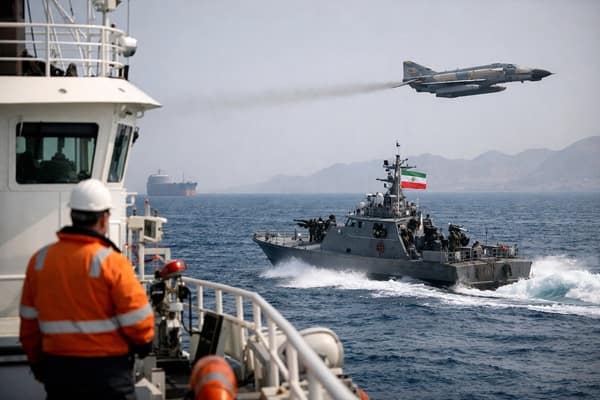
Iran has warned that any vessel attempting to pass through the Strait of Hormuz without its approval will be destroyed, in a dramatic escalation that threatens global energy supplies despite a fragile ceasefire effort.
According to a report by The Wall Street Journal, Iranian naval forces have been issuing radio warnings to ships in the region, insisting that all vessels must first obtain clearance from the Islamic Revolutionary Guard Corps Navy before transiting the narrow waterway.
“You must receive permission… Any vessel that attempts to transit without permission will be destroyed,” one such message reportedly stated.
The threat comes as Donald Trump signalled he would suspend US attacks on Iran for two weeks, on the condition that the strait is reopened in a “complete, immediate, and safe” manner. The proposed ceasefire — brokered with the involvement of Shehbaz Sharif and Asim Munir — is intended to ease tensions after nearly six weeks of conflict.
However, conditions on the ground suggest little immediate de-escalation. Most commercial vessels remain stationary, wary of the Iranian threat, while military aircraft continue to patrol the Persian Gulf, according to accounts from ship crews and imagery circulating online.
At just 34 kilometres wide at its narrowest point, the Strait of Hormuz is one of the world’s most critical chokepoints, handling roughly a fifth of global oil supplies as well as key goods such as fertiliser. Any disruption has immediate repercussions for international markets and energy prices.
The standoff casts doubt over the viability of the ceasefire agreement, which explicitly includes the reopening of the strait as a central condition. While Washington has stepped back from earlier threats — including potential strikes on Iranian infrastructure — Tehran’s actions suggest it is determined to retain control over the passage.
With both sides holding firm, the risk of miscalculation remains high. A single incident involving a commercial vessel or naval patrol could rapidly escalate, threatening not only the ceasefire but the stability of global energy flows.


