[ad_1]
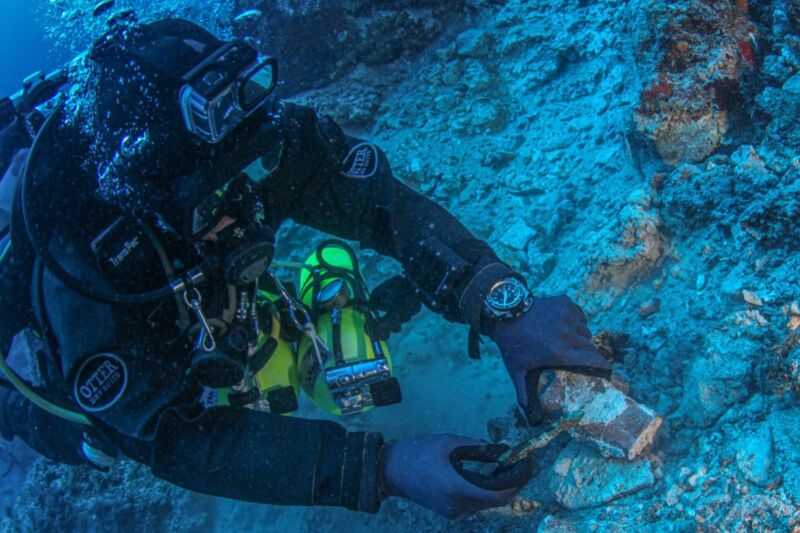
Nikos Giannoulakis/Return to Antikythera
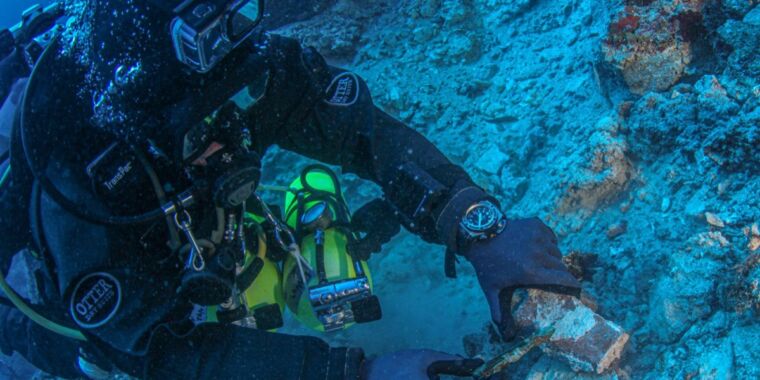
The so-called Antikythera mechanism, recovered from the wreckage of an ancient cargo ship off the coast of Antikythera Island in Greece, might be the world’s oldest analog computer. The mystery surrounding its purpose and origin continues to fascinate scientists and enthusiasts alike to this day. But it’s not the only treasure salvaged from that Antikythera wreck. An ongoing underwater archaeological project most recently recovered a large marble head of a bearded male figure believed to be part of a statue of Hercules. Divers also recovered a marble plinth with the lower legs of another statue, two human teeth, and several pieces of the cargo ship’s equipment.
As we’ve previously reported, in 1900, a Greek sponge diver named Elias Stadiatis discovered the wreck, which was apparently surrounded by rotting corpses on the sea floor. The captain, Dimitrios Kondos, didn’t believe Elias at first and thought the nitrogen in his breathing mix had affected the diver’s senses. So Kondos dove down to the site himself, emerging with an arm from a bronze statue.
Kondos and his crew had recovered all kinds of artifacts from the shipwreck by mid-1901, including 36 marble sculptures (representing Hercules, Ulysses, Diomedes, Hermes, and Apollo, among others); a bronze statue dubbed “The Philosopher” (circa 340 BCE); a bronze lyre; pieces of glasswork; and three marble horse statues. Along with the Antikythera mechanism, these precious artifacts are now housed in the National Archaeological Museum of Athens.
The salvage work ended that summer, however, after one diver died and two others were paralyzed from decompression sickness. No further attempt was made to excavate the treasures of the Antikythera wreck until famed explorer Jacques-Yves Cousteau visited the site in 1953. Twenty-three years later, Cousteau returned and worked with archaeologists to recover nearly 300 more artifacts. They dredged a section of the wreck to reveal artifacts previously hidden from view. These included hull planks, ceramic jars, bronze and silver coins, jewelry, and more marble and bronze statues. Cousteau’s 1976 expedition also recovered scattered human bones from at least four different people.
The wreck was left alone again for nearly 40 years until a Woods Hole Oceanographic Institute (WHOI) marine archaeologist named Brendan Foley (now at Lund University in Sweden) got permission from the Greek government in 2012 to undertake a complete diving survey of the wreckage site. As a bonus, they found a second ancient shipwreck just a few hundred meters south of the Antikythera wreck.
Foley’s team used mixed-gas closed-circuit rebreather technology for their survey, which gave divers over half an hour of time underwater each day—much longer than prior expeditions. Furthermore, the Exosuit—described as “Iron Man for underwater science”—allowed divers to descend to 1,000 feet (over 300 meters) and remain underwater for several hours, with no need to decompress as they returned to the surface.
[ad_2]
Source link


