[ad_1]
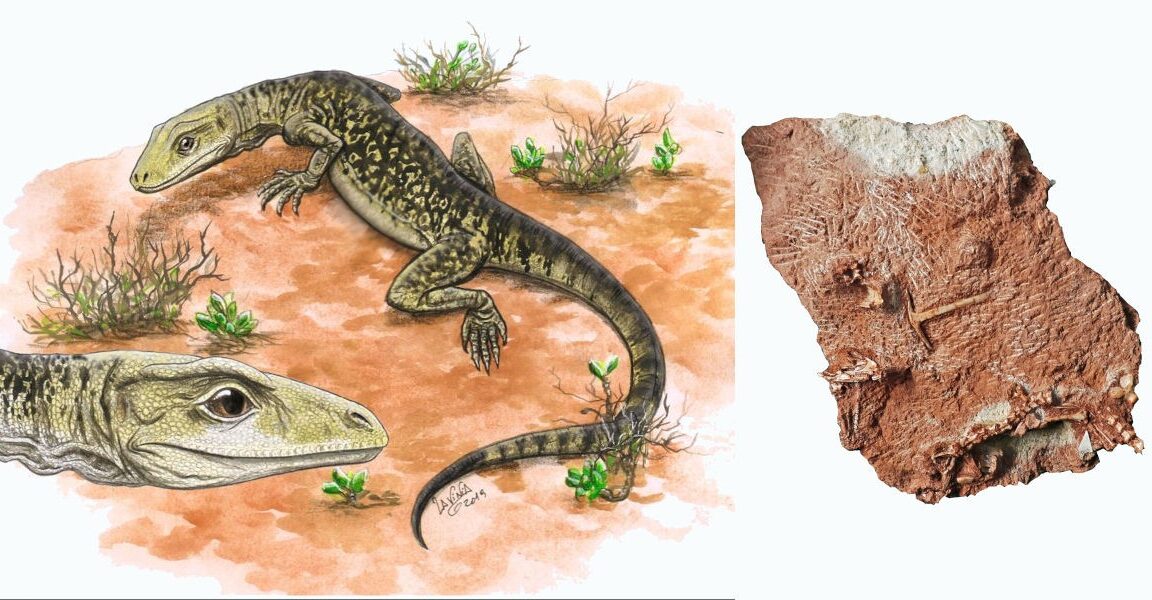
Lizards are ancient creatures. They were around before the dinosaurs and persisted long after dinosaurs went extinct. We’ve now found they are 35 million years older than we thought they were.
Cryptovaranoides microlanius was a tiny lizard that skittered around what is now southern England during the late Triassic, around 205 million years ago. It likely snapped up insects in its razor teeth (its name means “hidden lizard, small butcher”). But it wasn’t always considered a lizard. Previously, a group of researchers who studied the first fossil of the creature, or holotype, concluded that it was an archosaur, part of a group that includes the extinct dinosaurs and pterosaurs along with extant crocodilians and birds.
Now, another research team from the University of Bristol has analyzed that fossil and determined that Cryptovaranoides is not an archosaur but a lepidosaur, part of a larger order of reptiles that includes squamates, the reptile group that encompasses modern snakes and lizards. It is now also the oldest known squamate.
The misunderstandings about this species all come down to features in its bones that are squamate apomorphies. These are traits unique to squamates that were not present in their ancestral form, but evolved later. Certain forelimb bones, skull bones, jawbones, and even teeth of Cryptovaranoides share characteristics with those from both modern and extinct lizards.
Wait, what is that thing?
So what does the new team argue that the previous team that studied Cryptovaranoides gets wrong? The new paper argues that the interpretation of a few bones in particular stand out, especially the humerus and radius.
In the humerus of this lizard, structures called the ectepicondylar and entepicondylar foramina, along with the radial condyle, were either not considered or may have been misinterpreted. The entepicondylar foramen is an opening in the far end of the humerus, which is an upper arm bone in humans and upper forelimb bone in lizards. The ectepicondylar foramen is a structure on the outer side of the humerus where the extensor muscles attach, helping a lizard bend and straighten its legs. Both features are “often regarded as key lepidosaur and squamate characteristics,” the Bristol research team said in a study recently published in Royal Society Open Science.
[ad_2]
Source link


