[ad_1]
The orbiters that carried the radar hardware, along with one or two others, have been orbiting long enough that any major changes in Mars’ gravity caused by ice accumulation or crustal displacement would have shown up in their orbital behavior. The orbital changes they do see, “indicates that the increase in the gravitational potential associated with long-term ice accumulation is higher than the decrease in gravitational potential from downward deflection.” They calculate that the deformation has to be less than 0.13 millimeters per year to be consistent with the gravitational signal.
Finally, the model had to have realistic conditions at the polar ice cap, with a density consistent with a mixture of ice and dust.
Out of those 84 models, only three were consistent with all of these constraints. All three had a very viscous Martian interior, consistent with a relatively cold interior. That’s not a surprise, given what we’ve already inferred about Mars’ history. But it also suggests that most of the radioactive elements that provide heat to the red planet are in the crust, rather than deeper in the interior. That’s something we might have been able to check, had InSight’s temperature measurement experiment deployed correctly. But as it is, we’ll have to wait until some unidentified future mission to get a picture of Mars’ heat dynamics.
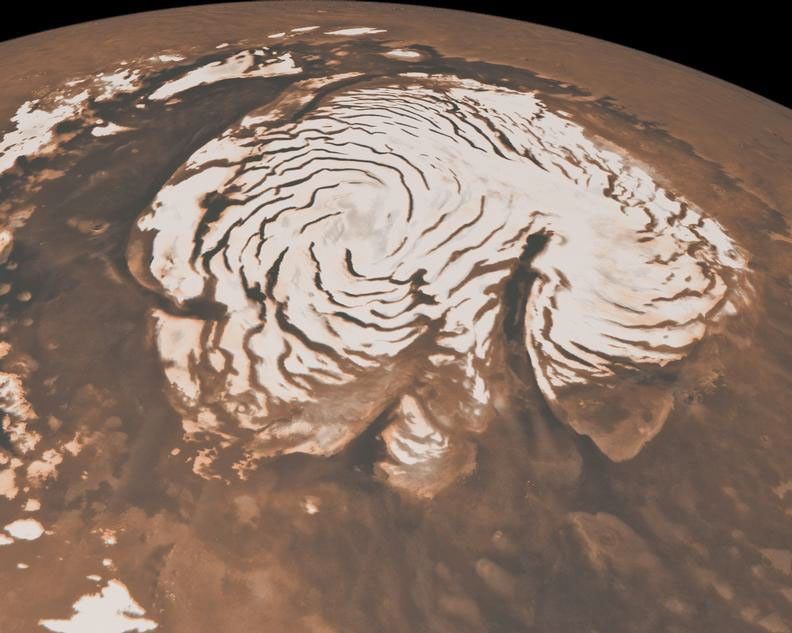
In any case, the models also suggest that Mars’ polar ice cap is less than 10 million years old, consistent with the orbitally driven climate models.
In a lot of ways, the new information is an update of earlier attempts to model the Martian interior, given a few more years of orbital data and the information gained from the InSight lander, which also determined the thickness of Mars’ crust and size of its core. But it’s also a good way of understanding how scientists can take bits and pieces of information from seemingly unrelated sources and build them into a coherent picture.
Nature, 2025. DOI: 10.1038/s41586-024-08565-9 (About DOIs).
[ad_2]
Source link


