
[ad_1]
The current generative Quake II demo represents a slight advancement from Microsoft’s previous generative AI gaming model (confusingly titled “WHAM” with only one “M”) we covered in February. That earlier model, while showing progress in generating interactive gameplay footage, operated at 300×180 resolution at 10 frames per second—far below practical modern gaming standards. The new WHAMM demonstration doubles the resolution to 640×360. However, both remain well below what gamers expect from a functional video game in almost every conceivable way. It truly is an AI tech demo.
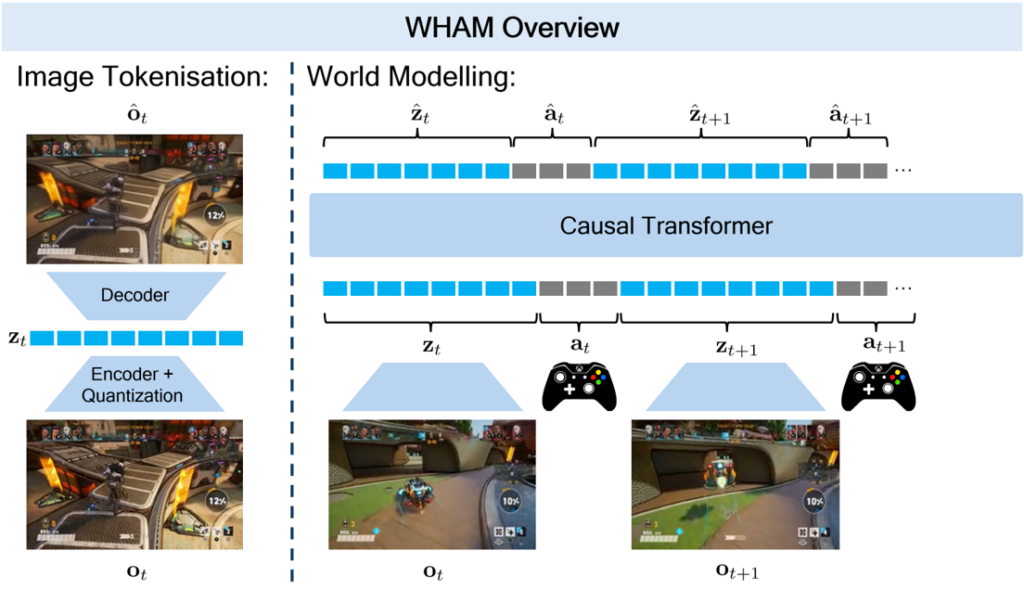
A Microsoft diagram of the WHAM system.
Credit:
Microsoft
For example, the technology faces substantial challenges beyond just performance metrics. Microsoft acknowledges several limitations, including poor enemy interactions, a short context length of just 0.9 seconds (meaning the system forgets objects outside its view), and unreliable numerical tracking for game elements like health values.
Which brings us to another point: A significant gap persists between the technology’s marketing portrayal and its practical applications. While industry veterans like Carmack and Sweeney view AI as another tool in the development arsenal, demonstrations like the Quake II instance may create inflated expectations about AI’s current capabilities for complete game generation.
The most realistic near-term application of generative AI technology remains as coding assistants and perhaps rapid prototyping tools for developers, rather than a drop-in replacement for traditional game development pipelines. The technology’s current limitations suggest that human developers will remain essential for creating compelling, polished game experiences for now. But given the general pace of progress, that might be small comfort for those who worry about losing jobs to AI in the near-term.
Ultimately, Sweeney says not to worry: “There’s always a fear that automation will lead companies to make the same old products while employing fewer people to do it,” Sweeney wrote in a follow-up post on X. “But competition will ultimately lead to companies producing the best work they’re capable of given the new tools, and that tends to mean more jobs.”
And Carmack closed with this: “Will there be more or less game developer jobs? That is an open question. It could go the way of farming, where labor-saving technology allow a tiny fraction of the previous workforce to satisfy everyone, or it could be like social media, where creative entrepreneurship has flourished at many different scales. Regardless, “don’t use power tools because they take people’s jobs” is not a winning strategy.”
[ad_2]
Source link


