[ad_1]
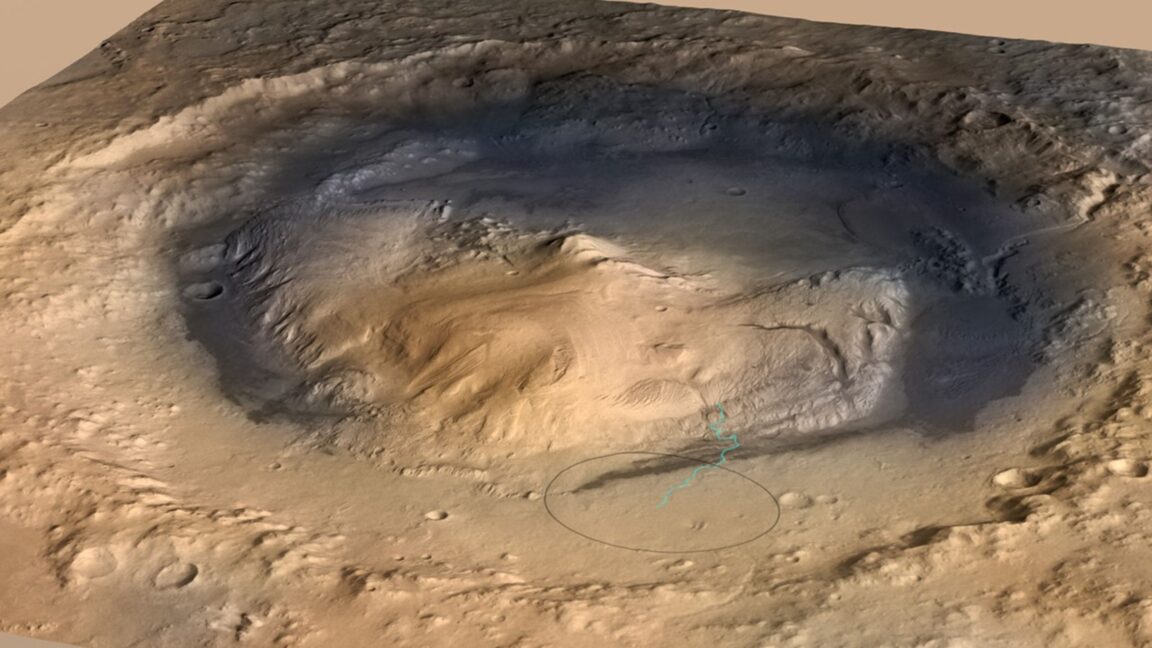
The Curiosity mission started near the bottom of the crater, at the base of a formation called Aeolis Mons, or Mount Sharp, where NASA expected to find the earliest geological samples. The idea then was to climb up Mount Sharp and collect samples from later and later geological periods at increasing elevations, tracing the history of habitability and the great drying up of Mars. On the way, the carbon missed by the satellites was finally found.
An imperfect cycle
Tutolo’s team focused their attention on four sediment samples Curiosity drilled after climbing over a kilometer up Mount Sharp. The samples were examined with the rover’s Chemistry and Mineralogy instrument, which uses X-ray diffraction to determine their composition. It turned out the samples contained roughly between 5 and 10 percent of siderite. “It was an iron carbonate, directly analogous to a mineral called calcite found in sedimentary rocks like limestone. The difference is it has iron in its cation site rather than calcium,” Tutolo explained. “We expected that because Mars is much richer in iron—that’s why it is the red planet.”
The siderite found in the samples was also pure, which Tutolo thinks indicates it has formed through an evaporation process akin to what we see in evaporated lakes on Earth. This, in turn, was the first evidence we’ve found of the ancient Martian carbon cycle. “Now we have evidence that confirms the models,” Tutolo claims. The carbon from the atmosphere was being sequestered in the rocks on Mars just as it is on Earth. The problem was, unlike on Earth, it couldn’t get out of these rocks.
“On Earth, whenever oceanic plates get subducted into the mantle, all of the limestone that was formed before gets cooked off, and the carbon dioxide gets back to the atmosphere through volcanoes,” Tutolo explains. Mars, on the other hand, has never had efficient plate tectonics. A large portion of carbon that got trapped in Martian rocks stayed in those rocks forever, thinning out the atmosphere. While it’s likely the red planet had its own carbon cycle, it was an imperfect one that eventually turned it into the lifeless desert it is today.
[ad_2]
Source link


