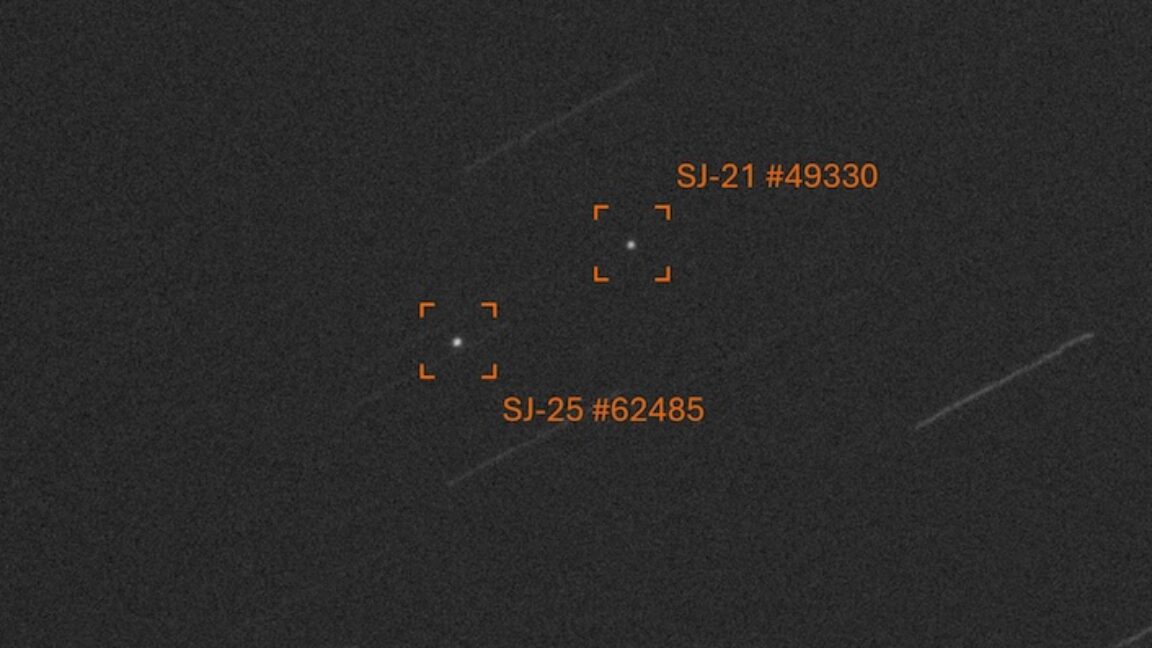
[ad_1]
“We’ve seen where GSSAP safely and responsibly approaches a Chinese vehicle, and it just quickly maneuvers away,” Shaw said. “We tend to fly our GSSAPs like dirigibles, using relatively slow, minimum energy transfer approaches. The Chinese know that we do that, so it is relatively easy for them to maneuver away today to avoid such an approach.
“If tomorrow they’re able to refuel at will and operate even more dynamically, then the marginal cost of those maneuvers for them becomes even lower, and the challenge for GSSAP becomes even greater,” Shaw said.
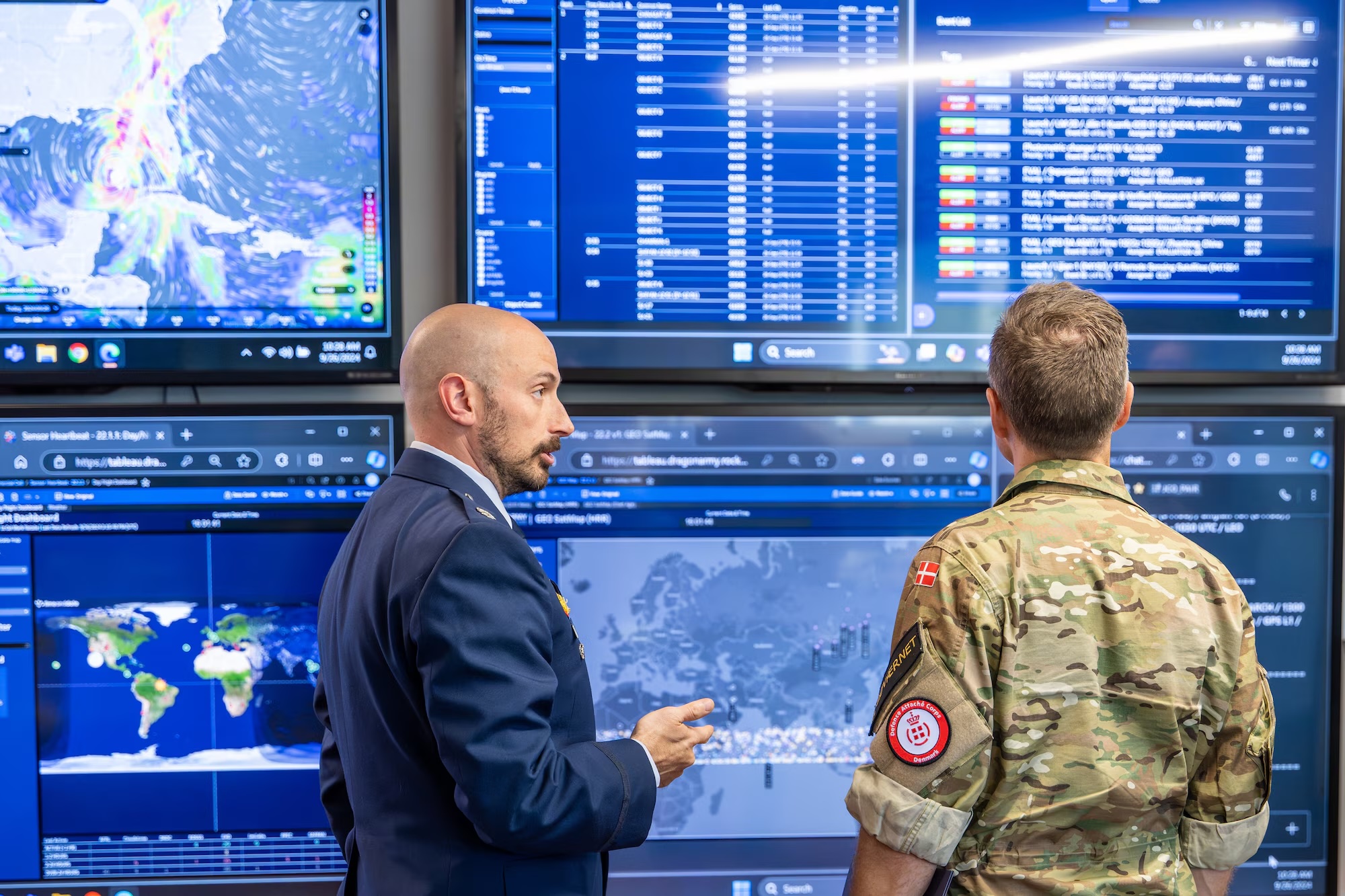
Danish Rear Admiral Damgaard Rousøe, Danish Defence Attaché, right, observes space domain awareness data with US Space Force Lt. Col. Mark Natale, left, Joint Commercial Operations cell director, in Colorado Springs, Colorado, on September 26, 2024.
Credit:
US Space Force/Dalton Prejeant
China launched a satellite into geosynchronous orbit in 2016 with a robotic arm that could grab onto another object in space, then sent SJ-21 into orbit four years ago on its “space debris mitigation” mission.
Northrop Grumman launched two satellites in 2019 and 2020 that accomplished the first dockings in geosynchronous orbit. Northrop’s satellites, which it calls Mission Extension Vehicles, took control of two aging commercial communications satellites running low on fuel, maneuvering them to new locations and allowing them to continue operating for several more years. It’s easy to see that this kind of technology could be used for commercial or military purposes.
But these Mission Extension Vehicles don’t have the ability to transfer fluids from one satellite to another. That is the step China is taking with SJ-21 and SJ-25, presumably with hydrazine and nitrogen tetroxide propellants, which most satellites use because they combust on contact with one another.
US Space Command’s Joint Commercial Operations cell, which collects unclassified satellite monitoring data to bolster the military’s classified data sources, estimated the SJ-21 and SJ-25 satellites “merged” on July 2 and have remained together since then. The video below, released by s2a systems, shows SJ-25 approaching SJ-21 on June 30.
A time-lapse of yesterday’s SJ-25 / SJ-21 coverage, recorded from 08:30 to 20:53 UTC. pic.twitter.com/HUPWBTXZc9
— s2a systems (@s2a_systems) July 1, 2025
The unclassified data does not confirm that the two satellites actually docked, but that is likely what happened. The satellites came together, or merged, on June 13 and June 30 but separated again within a few hours. These may have been practice runs, aborted docking attempts, or sudden maneuvers to avoid the prying eyes of the US military’s GSSAP satellites loitering nearby.
[ad_2]
Source link


