This article originally appeared on Inside Climate News, a nonprofit, non-partisan news organization that covers climate, energy, and the environment. Sign up for their newsletter here.
“We were getting basil leaves the size of your palm,” University of Arizona researcher Greg Barron-Gafford said, describing some of the benefits he and his team have seen farming under solar panels in the Tucson desert.
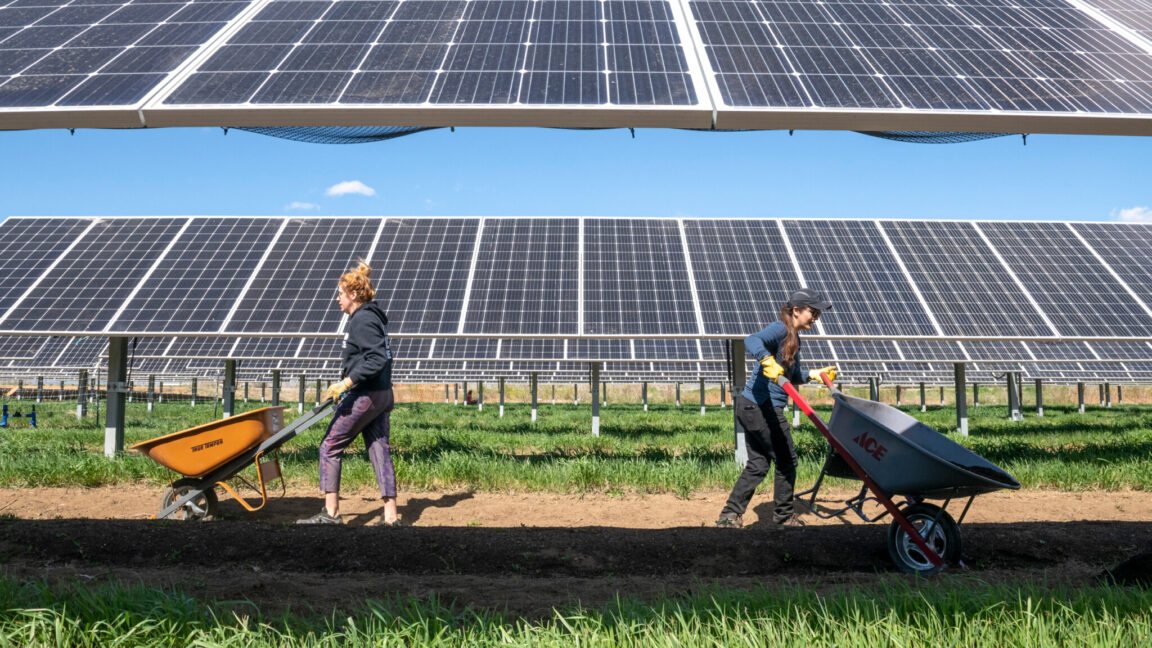
For 12 years, Barron-Gafford has been investigating agrivoltaics, the integration of solar arrays into working farmland. This practice involves growing crops or other vegetation, such as pollinator-friendly plants, under solar panels, and sometimes grazing livestock in this greenery. Though a relatively new concept, at least 604 agrivoltaic sites have popped up across the United States, according to OpenEI.
Researchers like Barron-Gafford think that, in addition to generating carbon-free electricity, agrivoltaics could offer a ray of hope for agriculture in an increasingly hotter and drier Southwest, as the shade created by these systems has been found to decrease irrigation needs and eliminate heat stress on crops. Plus, the cooling effects of growing plants under solar arrays can actually make the panels work better.
But challenges remain, including some farmers’ attitudes about the practice and funding difficulties.
Overcoming a climate conundrum
While renewable electricity from sources like solar panels is one of the most frequently touted energy solutions to help reduce the carbon pollution that’s driving climate change, the warming climate itself is making it harder for solar arrays to do their job, Barron-Gafford said. An optimal functioning temperature for panels is around 75° Fahrenheit, he explained. Beyond that, any temperature increase reduces the photovoltaic cells’ efficiency.
“You can quickly see how this solution for our changing climate of switching to more renewable energy is itself sensitive to the changing climate,” he said.
This problem is especially pertinent in the Southwest, where historically hot temperatures are steadily increasing. Tucson, for instance, saw a record-breaking 112 days of triple-digit heat in 2024, according to National Weather Service Data, and the US Environmental Protection Agency reports that every part of the Southwest experienced higher average temperatures between 2000 and 2023 compared to the long-term average from 1895 to 2023.


