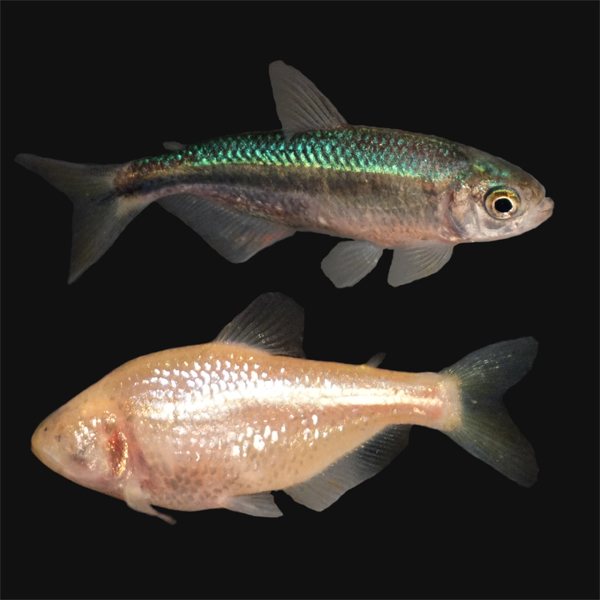
Instead, Riddle thinks these carotenoids may be another adaptation to suppress inflammation, which might be important in the wild, as cavefish are likely overeating whenever food arrives.
Studies by Krishnan, Rohner, and colleagues published in 2020 and 2022 have found other adaptations that seem to help tamp down inflammation. Cavefish cells produce lower levels of certain molecules called cytokines that promote inflammation, as well as lower levels of reactive oxygen species — tissue-damaging byproducts of the body’s metabolism that are often elevated in people with obesity or diabetes.
Krishnan is investigating this further, hoping to understand how the well-fed cavefish remain healthy. Rohner, meanwhile, is increasingly interested in how cavefish survive not just overeating, but long periods of starvation, too.
No waste
On a more fundamental level, researchers still hope to figure out why the Mexican tetra evolved into cave forms while any number of other Mexican river fish that also regularly end up in caves did not. (Globally, there are more than 200 cave-adapted fish species, but species that also still have populations on the surface are quite rare.) “Presumably, there is something about the tetras’ genetic makeup that makes it easier for them to adapt,” says Riddle.
Though cavefish are now well-established lab animals used in research and are easy to purchase for that purpose, preserving them in the wild will be important to safeguard the lessons they still hold for us. “There are hundreds of millions of the surface fish,” says Rohner, but cavefish populations are smaller and more vulnerable to pressures like pollution and people drawing water from caves during droughts.
One of Riddle’s students, David Perez Guerra, is now involved in a committee to support cavefish conservation. And researchers themselves are increasingly careful, too. “The tissues of the fish collected during our lab’s last field trip benefited nine different labs,” Riddle says. “We wasted nothing.”
This article originally appeared in Knowable Magazine, a nonprofit publication dedicated to making scientific knowledge accessible to all. Sign up for Knowable Magazine’s newsletter.


