[ad_1]
Chemistry that cools clouds
The first star-forming gas clouds, called protostellar clouds, were warm—roughly room temperature. Warm gas has internal pressure that pushes outward against the inward force of gravity trying to collapse the cloud. A hot air balloon stays inflated by the same principle. If the flame heating the air at the base of the balloon stops, the air inside cools, and the balloon begins to collapse.
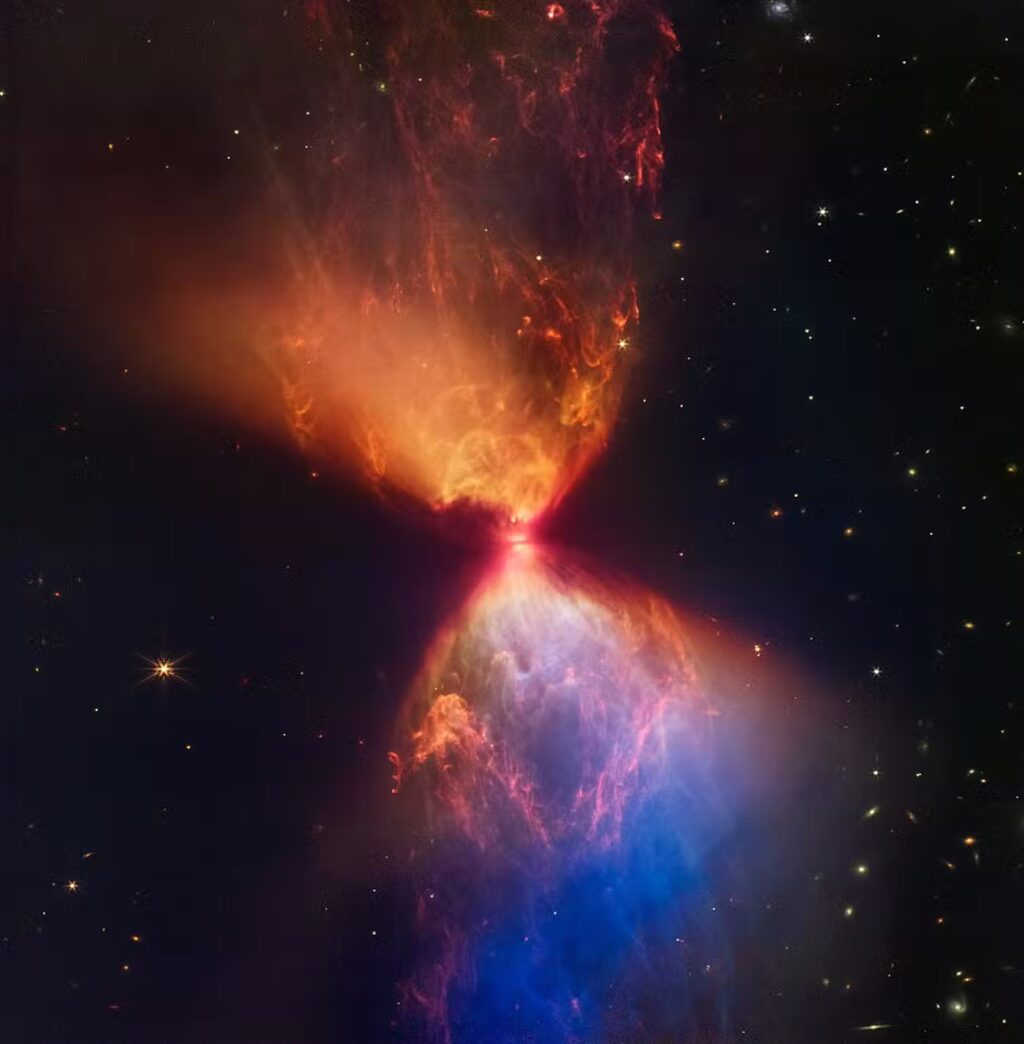
Only the most massive protostellar clouds with the most gravity could overcome the thermal pressure and eventually collapse. In this scenario, the first stars were all massive.
The only way to form the lower-mass stars we see today is for the protostellar clouds to cool. Gas in space cools by radiation, which transforms thermal energy into light that carries the energy out of the cloud. Hydrogen and helium atoms are not efficient radiators below several thousand degrees, but molecular hydrogen, H₂, is great at cooling gas at low temperatures.
When energized, H₂ emits infrared light, which cools the gas and lowers the internal pressure. That process would make gravitational collapse more likely in lower-mass clouds.
For decades, astronomers have reasoned that a low abundance of H₂ early on resulted in hotter clouds whose internal pressure would be too hot to easily collapse into stars. They concluded that only clouds with enormous masses, and therefore higher gravity, would collapse, leaving more massive stars.
Helium hydride
In a July 2025 journal article, physicist Florian Grussie and collaborators at the Max Planck Institute for Nuclear Physics demonstrated that the first molecule to form in the universe, helium hydride, HeH⁺, could have been more abundant in the early universe than previously thought. They used a computer model and conducted a laboratory experiment to verify this result.
[ad_2]
Source link


