[ad_1]
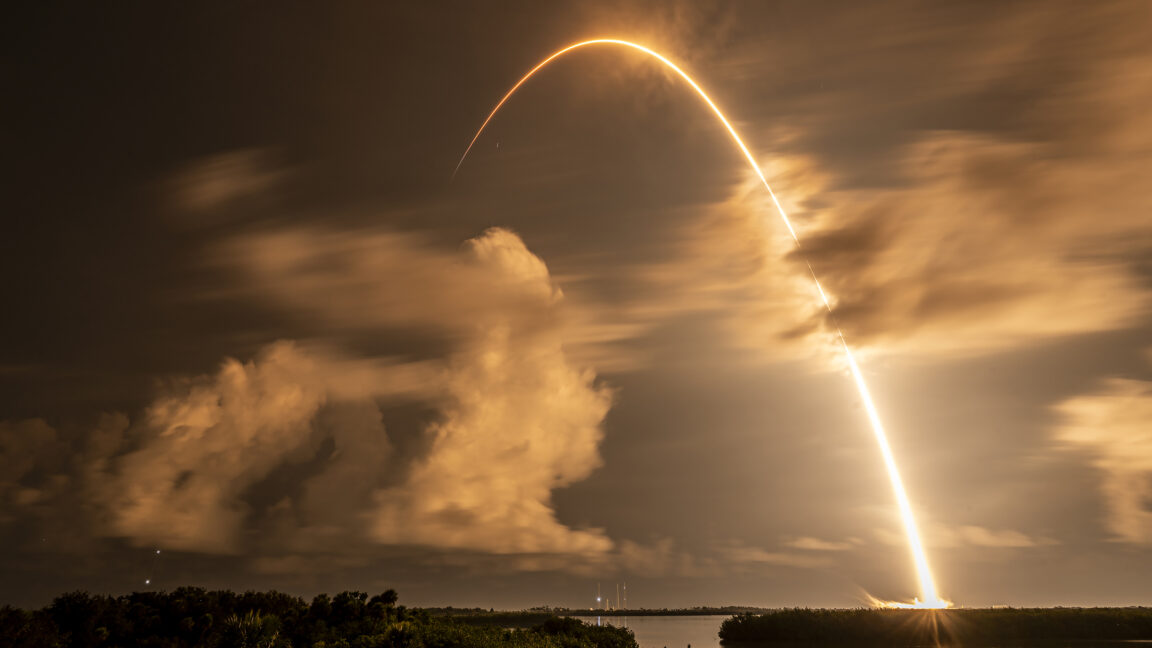
As SpaceX’s Starship vehicle gathered all of the attention this week, the company’s workhorse Falcon 9 rocket continued to hit some impressive milestones.
Both occurred during relatively anonymous launches of the company’s Starlink satellites but are nonetheless notable because they underscore the value of first-stage reuse, which SpaceX has pioneered over the last decade.
The first milestone occurred on Wednesday morning with the launch of the Starlink 10-56 mission from Cape Canaveral, Florida. The first stage that launched these satellites, Booster 1096, was making its second launch and successfully landed on the Just Read the Instructions drone ship. Strikingly, this was the 400th time SpaceX has executed a drone ship landing.
Then, less than 24 hours later, another Falcon 9 rocket launched the Starlink 10-11 mission from a nearby launch pad at Kennedy Space Center. This first stage, Booster 1067, subsequently returned and landed on another drone ship, A Shortfall of Gravitas.
This is a special booster, having made its debut in June 2021 and launching a wide variety of missions, including two Crew Dragon vehicles to the International Space Station and some Galileo satellites for the European Union. On Thursday, the rocket made its 30th flight, the first time a Falcon 9 booster has hit that level of experience.
A decade in the making
These milestones came about one decade after SpaceX began to have some success with first-stage reuse.
The company first made a controlled entry of the Falcon 9 rocket’s first stage in September 2013, during the first flight of version 1.1 of the vehicle. This proved the viability of the concept of supersonic retropropulsion, which was, until that time, just theoretical.
This involves igniting the rocket’s nine Merlin engines while the vehicle is traveling faster than the speed of sound through the upper atmosphere, with external temperatures exceeding 1,000 degrees Fahrenheit. Due to the blunt force of this reentry, the engines in the outer ring of the rocket wanted to get splayed out, the company’s chief of propulsion at the time, Tom Mueller, told me for the book Reentry. Success on the first try seemed improbable.
He recalled watching this launch from Vandenberg Space Force Base in California and observing reentry as a camera aboard SpaceX founder Elon Musk’s private jet tracked the rocket. The first stage made it all the way down, intact.
[ad_2]
Source link


