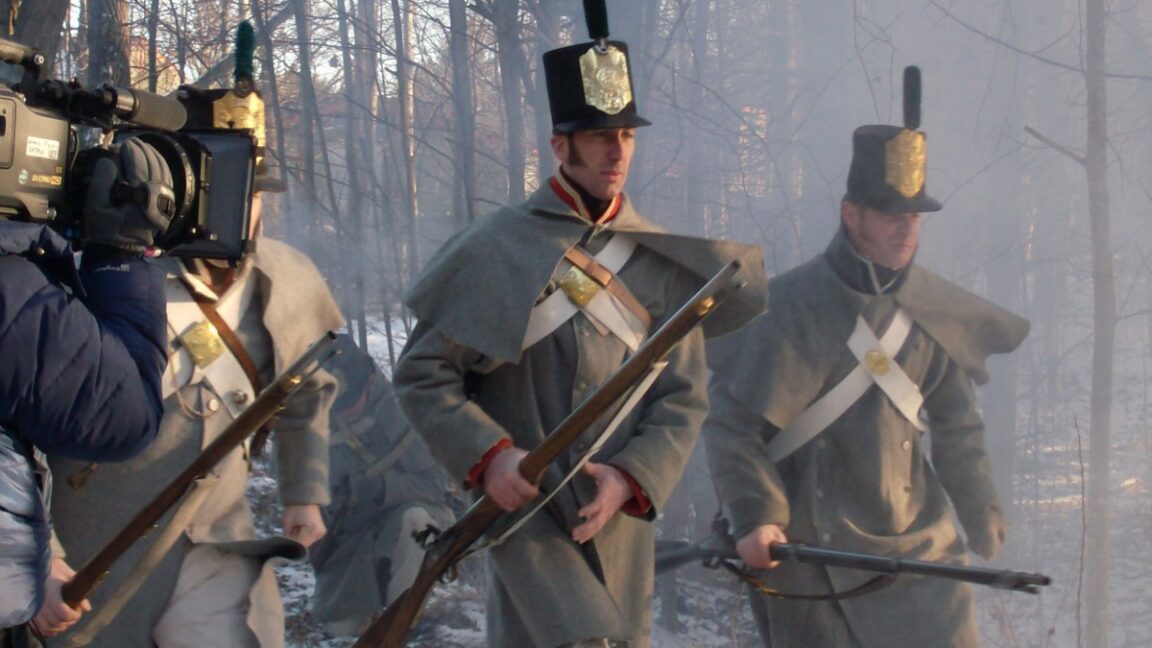
History buffs are no doubt familiar with the story of Shadrack Byfield, a rank-and-file British redcoat who fought during the War of 1812 and lost his left arm to a musket ball for his trouble. Byfield has been featured in numerous popular histories—including a children’s book and a 2011 PBS documentary—as a shining example of a disabled soldier’s stoic perseverance. But a newly rediscovered memoir that Byfield published in his later years is complicating that idealized picture of his post-military life, according to a new paper published in the Journal of British Studies.
Historian Eamonn O’Keeffe of Memorial University of Newfoundland in St. John’s, Canada, has been a Byfield fan ever since he read the 1985 children’s novel, Redcoat, by Gregory Sass. His interest grew when he was working at Fort York, a War of 1812-era fort and museum, in Toronto. “There are dozens of memoirs written by British rank-and-file veterans of the Napoleonic Wars, but only a handful from the War of 1812, which was much smaller in scale,” O’Keeffe told Ars. “Byfield’s autobiography seemed to offer an authentic, ground-level view of the fighting in North America, helping us look beyond the generals and politicians and grapple with the implications of this conflict for ordinary people.
Born in 1789 in Wiltshire’s Bradford-on-Avon suburbs, Byfield’s parents intended him to follow in his weaver father’s footsteps. He enlisted in the county militia when he turned 18 instead, joining the regular army the following year. When the War of 1812 broke out, Byfield was stationed at Fort George along the Niagara River, participating in the successful siege of Fort Detroit. At the Battle of Frenchtown in January 1813, he was shot in the neck, but he recovered sufficiently to join the campaigns against Fort Meigs and Fort Stephenson in Ohio.
After the British were defeated at the Battle of Thames later that year, he escaped into the woods with indigenous warriors, despite his concerns that they meant to kill him. They did not, and Byfield eventually rejoined other British fugitives and made his way back to the British lines. He was one of 15 out of 110 soldiers in his light company still alive after 18 months of fighting.
But his luck ran out in July 1814. While engaged in a skirmish at Conjocta Creek, a musket ball tore through his left forearm. Surgeons were forced to amputate after gangrene set in—a procedure that was performed without anesthesia. Byfield described the operation as “tedious and painful” in A Narrative of a Light Company Soldier’s Service, the memoir he published in 1840, adding, “I was enabled to bear it pretty well.”


