[ad_1]
Intuitive Machines
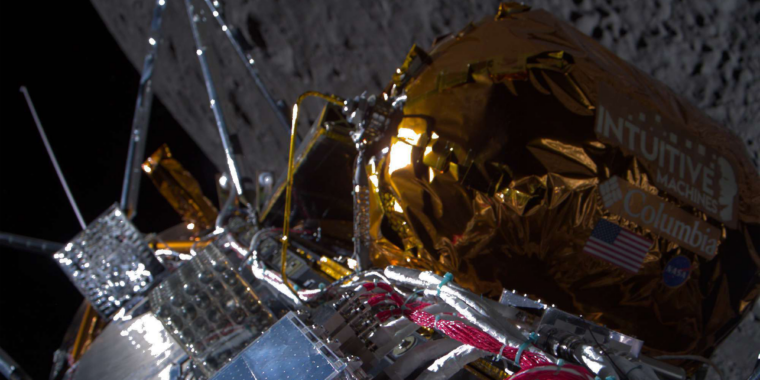
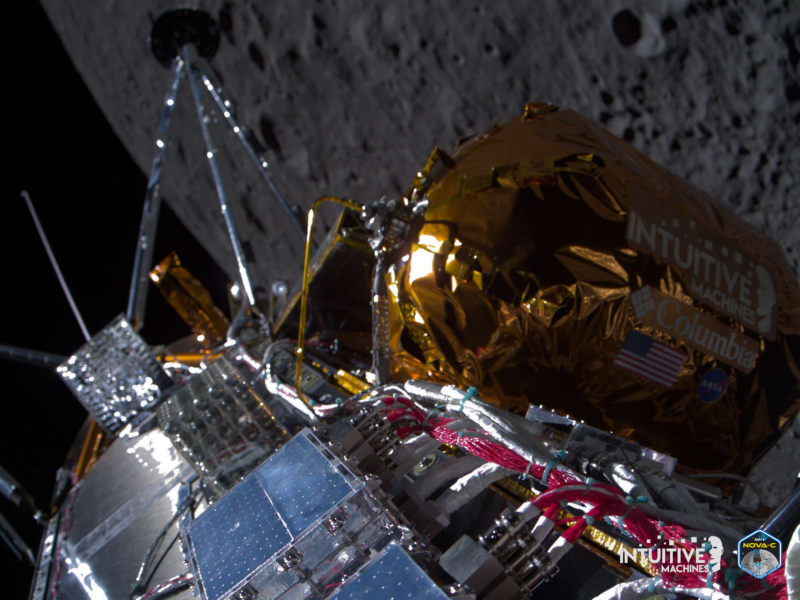
For the first time in more than half a century, a US-built spacecraft has made a soft landing on the Moon.
There was high drama and plenty of intrigue on Thursday evening as Intuitive Machines attempted to land its Odysseus spacecraft in a small crater not all that far from the south pole of the Moon. About 20 minutes after touchdown, NASA declared success, but some questions remained about the health of the lander and its orientation. Why? Because while Odysseus was phoning home, its signal was weak.
But after what the spacecraft and its developer, Houston-based Intuitive Machines, went through earlier on Thursday, it was a miracle that Odysseus made it at all.
Losing your way
The landing attempt was delayed by about two hours after mission controllers had to send a hastily cobbled together, last-minute software patch up to the lander while it was still in orbit around the Moon. Patching your spacecraft’s software shortly before it makes its most critical move is just about the last thing a vehicle operator wants to do. But Intuitive Machines was desperate.
Earlier on Thursday, the company realized that its navigation lasers and cameras were not operational. These rangefinders are essential for two functions during landing: terrain-relative navigation and hazard-relative navigation. These two modes help the flight computer on Odysseus to determine precisely where it is during descent—by snapping lots of images and comparing them to known Moon topography—and to identify hazards below, such as boulders, in order to find a safe landing site.
Without these rangefinders, Odysseus was going to faceplant into the Moon. Fortunately, this mission carried a bunch of science payloads. As part of its commercial lunar program, NASA is paying about $118 million for the delivery of six scientific payloads to the lunar surface.
One of these payloads just happened to be the Navigation Doppler Lidar experiment, a 15-kg package that contains three small cameras. With this NDL payload, NASA sought to test out technologies that might be used to improve navigation systems in future landing attempts on the Moon.
The only chance Odysseus had was if it could somehow tap into two of the NDL experiment’s three cameras and use one for terrain-relative navigation and the other for hazard-relative navigation. So, some software was hastily written and shipped up to the lander. This was some true MacGyver stuff. But would it work?
[ad_2]
Source link


