Last month, the parachutes on Hélène Huby’s small spacecraft failed to deploy, and the vehicle and its cargo crashed into the ocean on Earth.
It was both a success and a failure.
The success was that after Huby founded The Exploration Company in Europe, she managed to move nimbly with the “Mission Possible” spacecraft such that it cost less than $25 million to build and reached space in less than three years. The vehicle ticked off a number of successes in spaceflight before making a controlled descent through the atmosphere.
But at 26 km above the planet, as the spacecraft slowed to Mach one, The Exploration Company lost contact. Huby was not sure how this loss would be received in Europe, where failures in spaceflight have not been traditionally well-tolerated.
“What was interesting is the feedback I got in Europe,” Huby said in an interview this week at the company’s offices in Houston. “The German Space Agency, the French space agency, the European Space Agency said, OK, that’s a great achievement. For the time and money we spent, performing 80 percent of that mission was a good investment.”
No drop tests
After the spacecraft was lost on June 24, the company established an independent investigation team. Huby said it is “99 percent” confirmed there was a problem with the deployment of the parachutes, either the drogue chutes or the main parachutes. The fault was not with the provider of the parachutes themselves, US-based Airborne Systems, but the company’s mechanism, she said.
To save time and money, The Exploration Company did not conduct any drop tests. Such a campaign would have added millions of dollars to a program that was trying to be lean, plus a year of schedule to a mission attempting to move fast.
“We made a mistake, basically, to underestimate the risks,” she said. In retrospect, Huby added, the company could have done more testing on the ground.
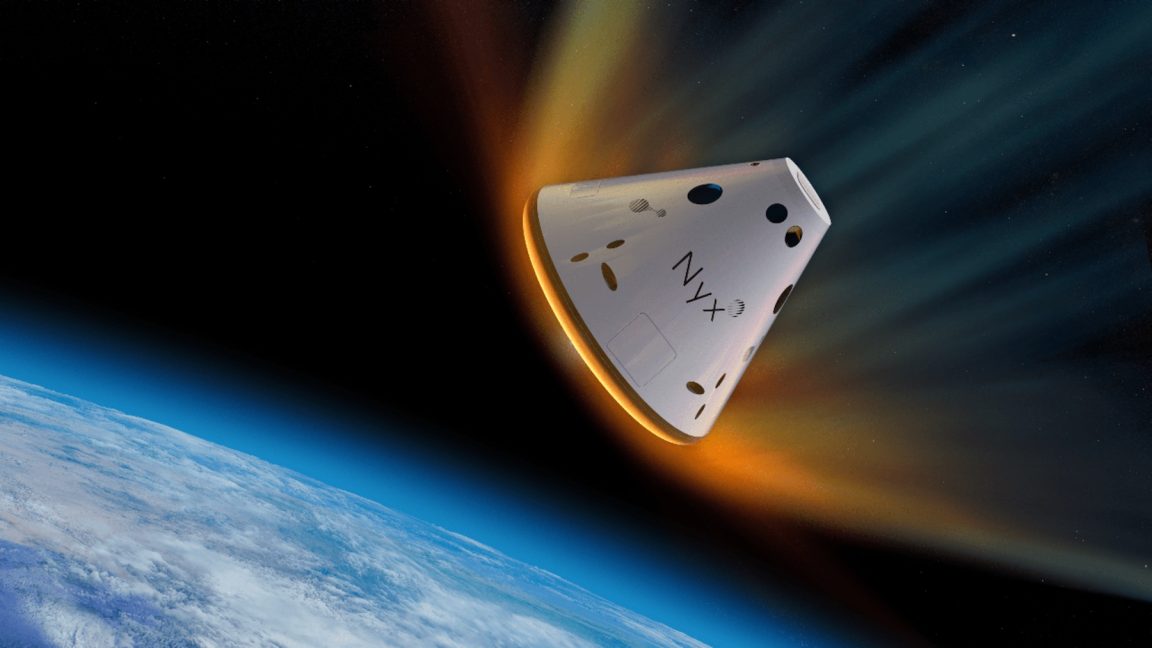
Now the firm faces a big decision: How to proceed from here. One option is building another small spacecraft, similar to Mission Possible, for testing purposes. But there is limited commonality in the parachute system for this vehicle and the larger Nyx spacecraft the company is building for operational missions. So if the Mission Possible parachutes were to work, that would not guarantee success for Nyx.


