[ad_1]
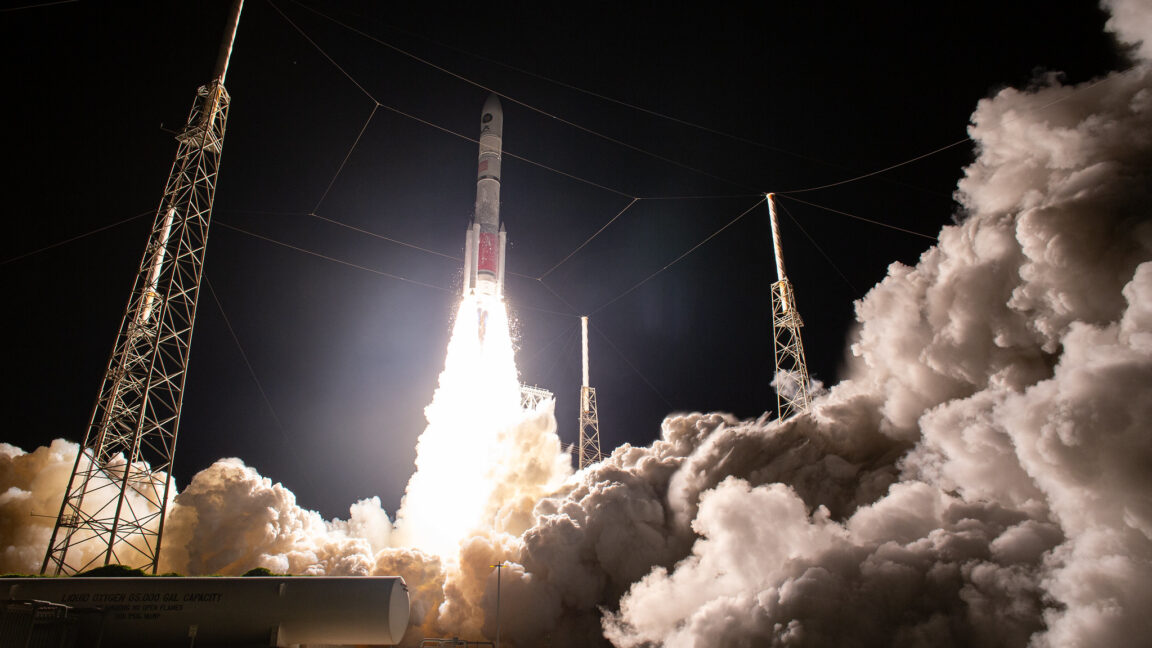
United Launch Alliance delivered multiple US military satellites into a high-altitude orbit after a prime-time launch Tuesday night, marking an important transition from development to operations for the company’s new Vulcan rocket.
This mission, officially designated USSF-106 by the US Space Force, was the first flight of ULA’s Vulcan rocket to carry national security payloads. Two test flights of the Vulcan rocket last year gave military officials enough confidence to certify it for launching the Pentagon’s medium-to-large space missions.
United Launch Alliance’s third 202-foot-tall (61.6-meter) Vulcan rocket lifted off from Cape Canaveral Space Force Station, Florida, at 8:56 pm EDT Tuesday (00:56 UTC Wednesday). Two methane-burning BE-4 main engines, supplied by Jeff Bezos’ space company Blue Origin, and four solid-fueled boosters from Northrop Grumman powered the rocket off the launch pad with nearly 3 million pounds of thrust.
The rocket steered east from Florida’s Space Coast and climbed through the atmosphere, shedding its four strap-on boosters, core stage, and payload fairing to fall into the Atlantic Ocean. Vulcan’s Centaur upper stage ignited its RL10 engines several times to maneuver into a near-circular geosynchronous orbit more than 22,000 miles (nearly 36,000 kilometers) over the equator.
These maneuvers took approximately seven hours to complete before the Centaur upper stage released its payloads to begin their missions. One of the satellites is an experimental platform to test next-generation technologies that may improve GPS navigation. There was at least one additional satellite—and perhaps more—aboard the rocket that the Space Force declined to discuss publicly.
Taking a bite of the apple
ULA and Space Force officials declared success early Wednesday, celebrating the Vulcan rocket’s entry into service as ULA begins the challenging task of working through a firm backlog of more than 70 Vulcan launches on contract. Nearly all of the Vulcan launches have been booked by the Space Force’s National Security Space Launch (NSSL) program and by Amazon for its Kuiper satellite broadband network.
Col. Jim Horne, USSF-106 mission director, said in a statement, “It’s an exciting day for us as we launched the first NSSL flight of Vulcan, an outstanding achievement for United Launch Alliance and the nation’s strategic space lift capability. This is an important milestone for the Space Force and all involved.” He added, “After years of development, technical collaboration, and dedication by all involved, including our government mission partners and the entire ULA team, I’m proud to say the first Vulcan NSSL mission delivered its payloads safely into space.”
[ad_2]
Source link


