Ukraine is facing growing pressure from its own allies to scale back one of its most effective wartime strategies: long-range drone strikes on Russian oil infrastructure.
According to Kyrylo Budanov, Kyiv has received “signals” from partners urging restraint, as the widening conflict involving Iran begins to ripple across global energy markets.
The backdrop to these requests is the escalating conflict in the Middle East, where fighting involving the United States and Israel has now entered its sixth week.
At the centre of the crisis is the Strait of Hormuz, a chokepoint through which roughly 20% of the world’s oil supply passes.
Iran’s closure of the strait has sent oil prices sharply higher, intensifying fears of a global supply shock.
In this context, Ukraine’s campaign against Russian refineries — while strategically effective — is increasingly seen by some allies as adding further strain to already volatile markets.
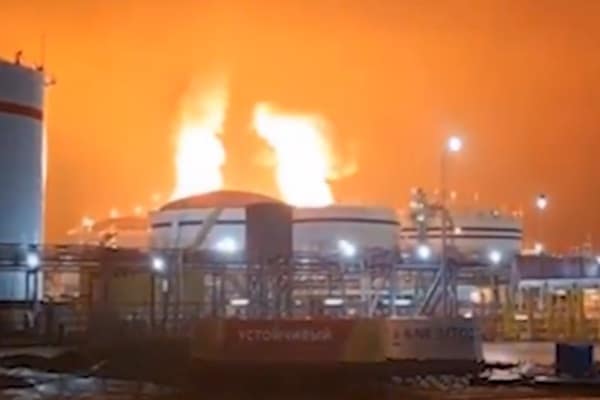
Since 2024, Ukraine has systematically targeted Russia’s energy infrastructure, using long-range drones to strike refineries, storage facilities and pipelines deep inside Russian territory.
Kyiv views these sites as legitimate military targets, arguing they directly fund and sustain the Kremlin’s war effort.
The impact has been significant.
According to reporting cited by Reuters, Ukrainian strikes combined with other disruptions such as seizures of shadow fleet tankers have cut Russia’s oil export capacity by as much as 40%, described as one of the most severe supply disruptions in modern Russian history.
Recent attacks have hit major facilities, including the Saratov refinery and the Kirishi plant, the latter of which accounts for more than 6 per cent of Russia’s refined output.
The emerging tension highlights a growing dilemma for Ukraine and its partners.
On one hand, degrading Russia’s energy sector remains one of Kyiv’s most effective tools for weakening the Kremlin’s ability to finance the war.
On the other hand, global energy stability — particularly amid a Middle Eastern conflict — has become a competing priority for Western governments.
The United States has already taken steps to ease pressure on global markets. In March, Washington issued a temporary licence allowing the sale of Russian oil stranded at sea, a move aimed at stabilising prices as they surged above $100 per barrel.
The effect has been immediate. Russia is estimated to have earned billions in additional revenue during the early weeks of the Iran conflict — a financial windfall that partially offsets the damage inflicted by Ukrainian strikes.
Notably, Kyrylo Budanov did not specify which countries had urged restraint, nor did he indicate whether Ukraine would comply.
His response — “let’s address this diplomatically” — suggests the issue remains under active discussion rather than settled policy.
For now, there is little sign of a slowdown. Ukrainian forces continue to strike Russian energy assets, including a confirmed April 3 attack on the Bashneft-Novoil refinery in Ufa, a major producer of high-grade lubricants with a refining capacity of around seven million tonnes per year.
The situation underscores a broader reality: the war in Ukraine is no longer an isolated conflict.
It is now deeply entangled with global energy markets, Middle Eastern instability, and great power competition.
Actions taken on the battlefield — whether in eastern Ukraine or deep inside Russia — are increasingly having consequences far beyond the immediate theatre of war.
For Kyiv, the challenge is acute.
Scaling back strikes risks easing pressure on Moscow at a critical moment. Continuing them risks alienating allies and contributing to global economic instability.
For Western governments, the calculation is equally complex: how to support Ukraine’s war effort without triggering wider economic shockwaves.
As long as the Iran conflict continues to disrupt global energy flows, that tension is unlikely to ease.
And for Ukraine, one of its most effective weapons may also be one of its most diplomatically sensitive.


