[ad_1]
AMD announced its fourth-quarter earnings yesterday, and the numbers were mostly rosy: $7.7 billion in revenue and a 51 percent profit margin, compared to $6.2 billion and 47 percent a year ago. The biggest winner was the data center division, which made $3.9 billion thanks to Epyc server processors and Instinct AI accelerators, and Ryzen CPUs are also selling well, helping the company’s client segment earn $2.3 billion.
But if you were looking for a dark spot, you’d find it in the company’s gaming division, which earned a relatively small $563 million, down 59 percent from a year ago. AMD’s Lisa Su blamed this on both dedicated graphics card sales and sales from the company’s “semi-custom” chips (that is, the ones created specifically for game consoles like the Xbox and PlayStation).
Other data sources suggest that the response from GPU buyers to AMD’s Radeon RX 7000 series, launched between late 2022 and early 2024, has been lackluster. The Steam Hardware Survey, a noisy but broadly useful barometer for GPU market share, shows no RX 7000-series models in the top 50; only two of the GPUs (the 7900 XTX and 7700 XT) are used in enough gaming PCs to be mentioned on the list at all, with the others all getting lumped into the “other” category. Jon Peddie Research recently estimated that AMD was selling roughly one dedicated GPU for every seven or eight sold by Nvidia.
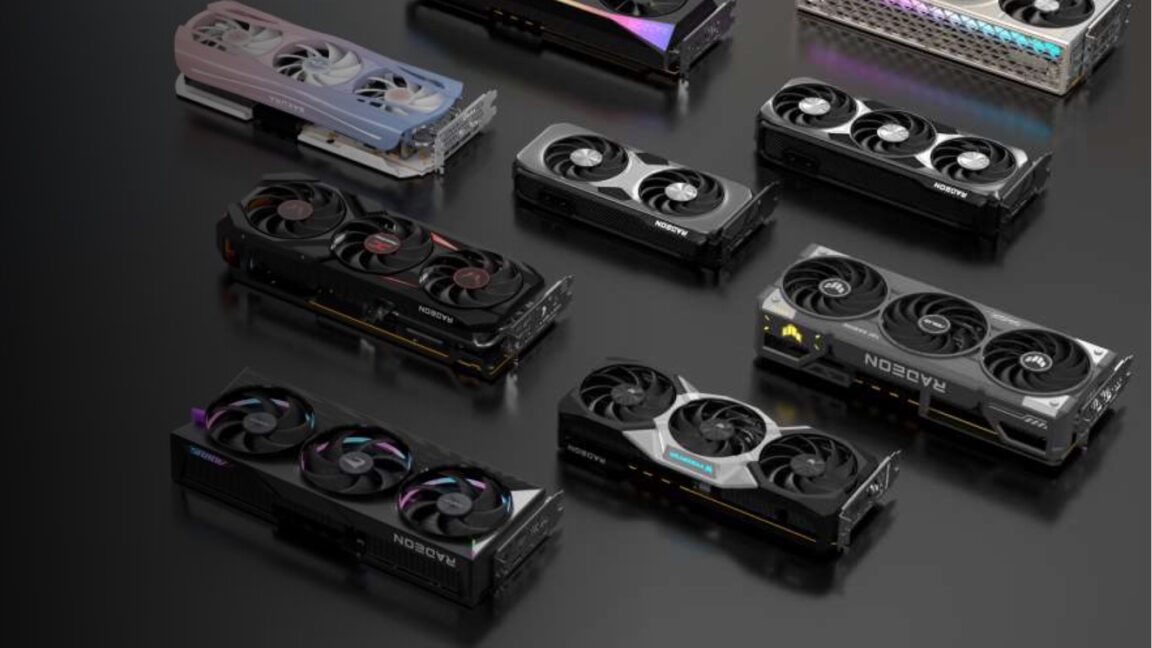
But hope springs eternal. Su confirmed on AMD’s earnings call that the new Radeon RX 9000-series cards, announced at CES last month, would be launching in early March. The Radeon RX 9070 and 9070 XT are both aimed toward the middle of the graphics card market, and Su said that both would bring “high-quality gaming to mainstream players.”
An opportunity, maybe
“Mainstream” could mean a lot of things. AMD’s CES slide deck positioned the 9070 series alongside Nvidia’s RTX 4070 Ti ($799) and 4070 Super ($599) and its own RTX 7900 XT, 7900 GRE, and 7800 XT (between $500 and $730 as of this writing), a pretty wide price spread that is still more expensive than an entire high-end console. The GPUs could still rely heavily on upscaling algorithms like AMD’s Fidelity Super Resolution (FSR) to hit playable frame rates at those resolutions, rather than targeting native 4K.
[ad_2]
Source link


