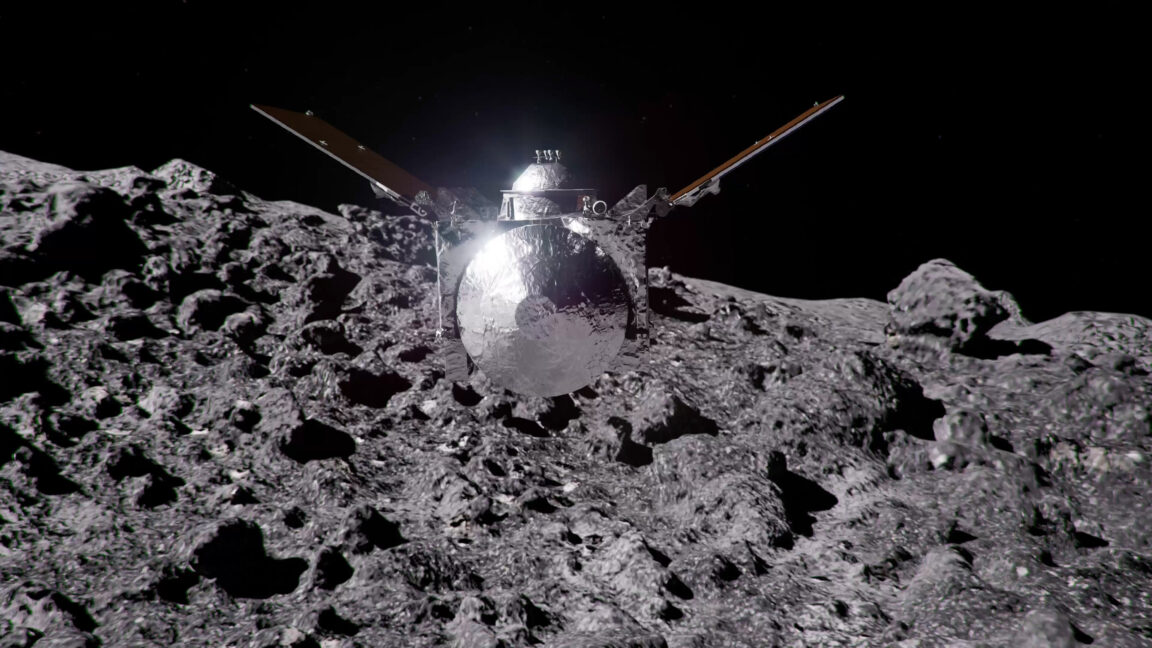
The second thing Lu urged NASA to do is develop a follow-up mission to DART. It was successful, he said, but DART was just an initial demonstration. Such a capability needs to be tested against a larger asteroid with different properties.
An asteroid that might look a lot like Apophis.
About Apophis
Astronomers using a telescope in Arizona found Apophis in 2004, and they were evidently fans of the television series Stargate SG-1, in which a primary villain who threatens civilization on Earth is named Apophis.
Because of its orbit, Apophis comes near Earth about every eight years. It is fairly large, about 370 meters across. This is not big enough to wipe out civilization on Earth, but it would cause devastating consequences across a large region, imparting about 300 times as much impact force on the planet as the Tunguska event in 1908, over Siberia. It will miss Earth by about 31,600 km (19,600 miles) on April 13, 2029.
“We like to say that’s because nature has a sense of humor,” said Binzel, the MIT asteroid scientist, of this date.
Astronomers estimate that an asteroid this large comes this close to Earth only about once every 7,500 years. It also appears to be a stony, non-metallic type of asteroid known as an ordinary chondrite. This is the most common type of asteroid in the Solar System.
Areas of the planet that will be able to see Apophis at its closest approach to Earth in April 2029.
Credit:
Rick Binzel
All of this is rather convenient for scientists hoping to understand more about potential asteroids that might pose a serious threat to the planet.
The real cherry on top with the forthcoming encounter is that Apophis will be perturbed by Earth’s gravitational pull.
“Nature is handing us an incredibly rare experiment where the Earth’s gravity is going to tug and stretch this asteroid,” Binzel said. “By seeing how the asteroid responds, we’ll know how it is put together, and knowing how an asteroid is put together is maybe the most important information we could have if humanity ever faces an asteroid threat.”
In nearly seven decades of spaceflight, humans have only ever probed the interior of three celestial bodies: the Earth, the Moon, and Mars. We’re now being offered the opportunity to probe a fourth, right on our doorstep.
But time is ticking.
Chasing Apophis
On paper, at least, NASA has a plan to rendezvous with Apophis. About three years ago, after a senior-level review, NASA extended the mission of the OSIRIS-REx spacecraft to rendezvous with Apophis.


