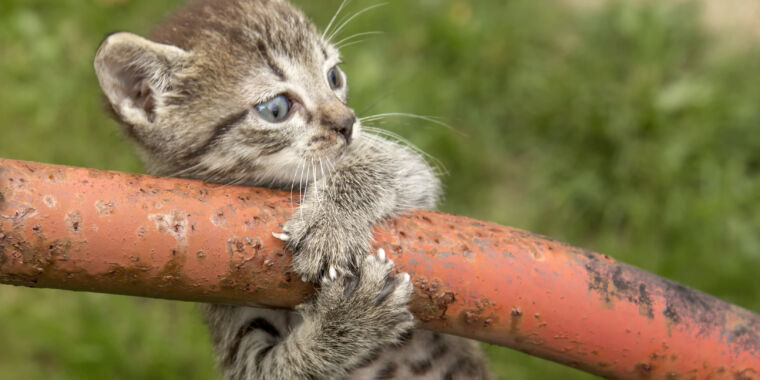
Isaac Newton would never have discovered the laws of motion had he studied only cats.
Suppose you hold a cat, stomach up, and drop it from a second-story window. If a cat is simply a mechanical system that obeys Newton’s rules of matter in motion, it should land on its back. (OK, there are some technicalities—like this should be done in a vacuum, but ignore that for now.) Instead, most cats usually avoid injury by twisting themselves on the way down to land on their feet.
Most people are not mystified by this trick—everybody has seen videos attesting to cats’ acrobatic prowess. But for more than a century, scientists have wondered about the physics of how cats do it. Clearly, the mathematical theorem analyzing the falling cat as a mechanical system fails for live cats, as Nobel laureate Frank Wilczek points out in a recent paper.
“This theorem is not relevant to real biological cats,” writes Wilczek, a theoretical physicist at MIT. They are not closed mechanical systems, and can “consume stored energy … empowering mechanical motion.”
Nevertheless, the laws of physics do apply to cats—as well as every other kind of animal, from insects to elephants. Biology does not avoid physics; it embraces it. From friction on microscopic scales to fluid dynamics in water and air, animals exploit physical laws to run or swim or fly. Every other aspect of animal behavior, from breathing to building shelters, depends in some way on the restrictions imposed, and opportunities permitted, by physics.
“Living organisms are … systems whose actions are constrained by physics across multiple length scales and timescales,” Jennifer Rieser and coauthors write in the current issue of the Annual Review of Condensed Matter Physics.
While the field of animal behavior physics is still in its infancy, substantial progress has been made in explaining individual behaviors, along with how those behaviors are shaped via interactions with other individuals and the environment. Apart from discovering more about how animals perform their diverse repertoire of skills, such research may also lead to new physics knowledge gained by scrutinizing animal abilities that scientists don’t yet understand.
Critters in motion
Physics applies to animals in action over a wide range of spatial scales. At the smallest end of the range, attractive forces between nearby atoms facilitate the ability of geckos and some insects to climb up walls or even walk on ceilings. On a slightly larger scale, textures and structures provide adhesion for other biological gymnastics. In bird feathers, for instance, tiny hooks and barbs act like Velcro, holding feathers in position to enhance lift when flying, Rieser and colleagues report.
Biological textures also aid movement by facilitating friction between animal parts and surfaces. Scales on California king snakes possess textures that allow rapid forward sliding, but increase friction to retard backward or sideways motion. Some sidewinding snakes have apparently evolved different textures that reduce friction in the direction of motion, recent research suggests.
Small-scale structures are also important for animals’ interaction with water. For many animals, microstructures make the body “superhydrophobic”—capable of blocking the penetration of water. “In wet climates, water droplet shedding can be essential in animals, like flying birds and insects, where weight and stability are crucially important,” note Rieser, of Emory University, and coauthors Chantal Nguyen, Orit Peleg and Calvin Riiska.
Water-blocking surfaces also help animals keep their skins clean. “This self-cleansing mechanism … can be important to help protect the animal from dangers like skin-borne parasites and other infections,” the Annual Review authors explain. And in some cases, removing foreign material from an animal’s surface may be necessary to preserve the surface properties that enhance camouflage.


