[ad_1]
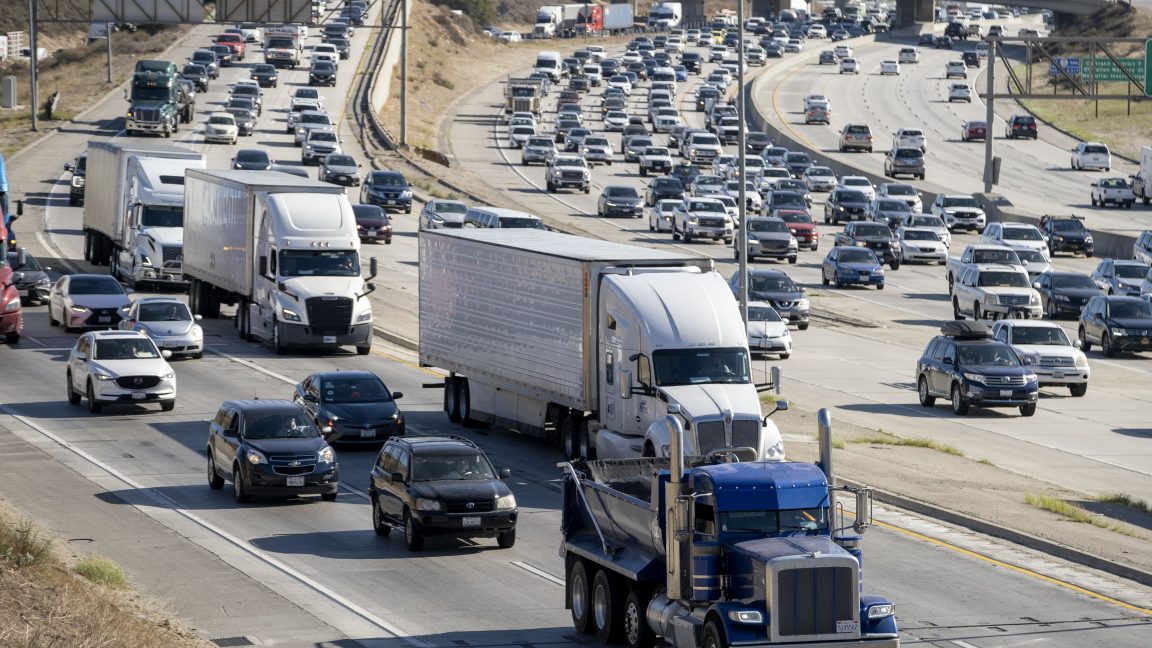
Where trucks congregate
There’s also a policy tool called indirect source rules, or ISR.
The rules are called “indirect” because they don’t regulate the vehicles themselves, but the facilities that attract emissions-heavy traffic, like large warehouses, ports, or rail yards. The rules hold the facilities owners or operators responsible for reducing or offsetting the pollution from their profitable traffic.
Studies show that the pollution from these trucks often ends up in nearby neighborhoods, which are disproportionately lower-income and communities of color.
California is currently the only state enforcing ISRs.
In Southern California, large warehouses must take steps to reduce the pollution caused by truck visits, either by switching to electric vehicles, installing chargers, or paying into a clean air fund. It’s the first rule of its kind in the country and it survived a court challenge in 2023, paving the way for other states to consider similar action.
New York is one of them. Its lawmakers introduced a bill in January that could require warehouses with over 50,000 square feet to reduce emissions from trucks by meeting certain benchmarks, such as hosting electric deliveries or offering bike loading zones. New York City has its own version of the rule under deliberation in the Council. As of June 2025, the bill remains stalled in the environmental committee. City Council has until December to act before the bill expires.
In New Jersey, where warehouse growth has boomed, legislators in 2024 proposed a bill that would require “high-traffic facilities” to apply for air pollution permits and provide plans to reduce diesel truck pollution.
“This is really being pushed by the community groups and environmental justice communities, especially in North Jersey. But also, warehouses are starting to pop up even in very rural parts of South Jersey. So this is very quickly becoming a statewide issue in New Jersey,” said Ambrose of the New Jersey Policy Perspective.
In Colorado, its regional air quality council in April announced plans to ask its air quality control commission to use ISR for areas with the worst air quality.
Industry groups, especially in the logistics sector, are pushing back. The industry group Supply Chain Federation told The Wall Street Journal that the southern California ISR was a “backdoor approach [that] does little to cut emissions and instead raises costs, disrupts supply chains.”
Still, experts say this may be one of the few options left for states to cut emissions from traffic-heavy facilities. Because these rules don’t directly regulate the car companies or trucks themselves, they don’t need federal approval.
“We definitely have to be nimble and fluid and also understand the kind of landscape in the state,” DelloIacono said.
[ad_2]
Source link


