[ad_1]
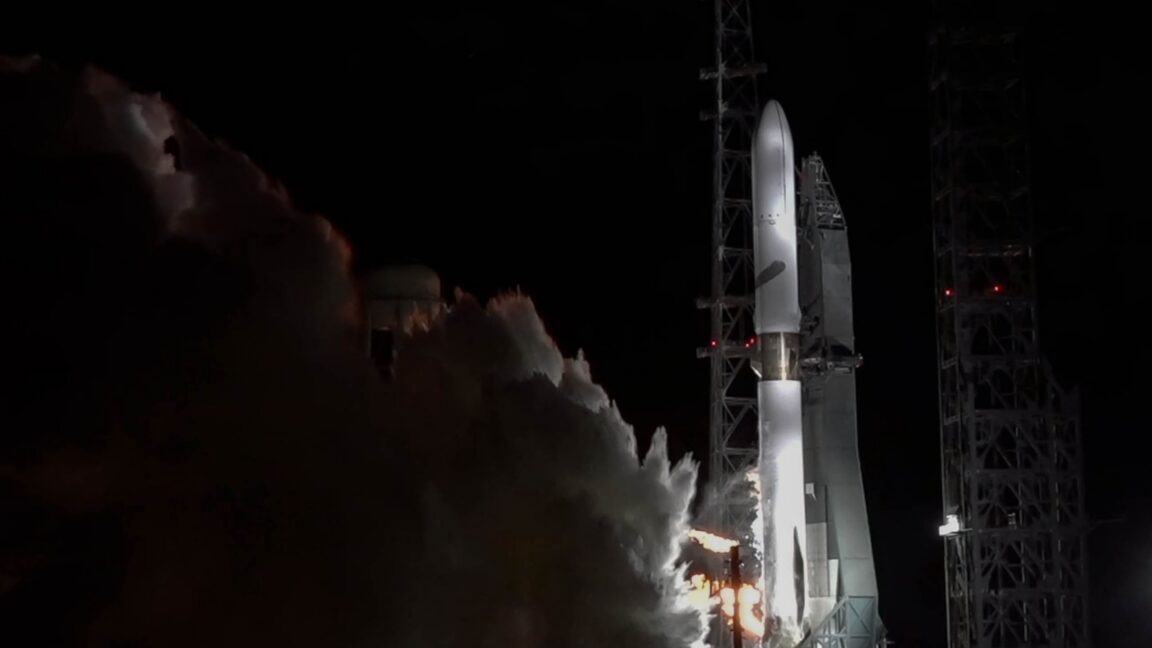
The road to the second flight of Blue Origin’s heavy-lifting New Glenn rocket got a lot clearer Thursday night with a success test-firing of the launcher’s seven main engines on a launch pad at Cape Canaveral Space Force Station, Florida.
Standing on a seaside launch pad, the New Glenn rocket ignited its seven BE-4 main engines at 9:59 pm EDT Thursday (01:59 UTC Friday). The engines burned for 38 seconds while the rocket remained firmly on the ground, according to a social media post by Blue Origin.
The hold-down firing of the first stage engines was the final major test of the New Glenn rocket before launch day. Blue Origin previously test-fired the rocket’s second-stage engines. Officials have not announced a target launch date, but sources tell Ars the rocket could be ready for liftoff as soon as November 9.
“Love seeing New Glenn’s seven BE-4 engines come alive! Congratulations to Team Blue on today’s hotfire,” the company’s CEO, Dave Limp, posted on X.
Blue Origin, the space company owned by billionaire Jeff Bezos, said the engines operated at full power for 22 seconds, generating nearly 3.9 million pounds of thrust. Limp said engineers extended this test-firing and shut down some of the BE-4 engines to simulate the booster’s landing burn sequence, which Blue Origin hopes will culminate in a successful touchdown on a barge floating downrange in the Atlantic Ocean.
“This helps us understand fluid interactions between active and inactive engine feedlines during landing,” Limp wrote.
Blue Origin is counting on recovering the New Glenn first stage on the next flight after missing the landing on the rocket’s inaugural mission in January. Officials plan to reuse this booster on the third New Glenn launch early next year, slated to propel Blue Origin’s first unpiloted Blue Moon lander toward the Moon. If Blue Origin fails to land this rocket, it’s unlikely a new first stage booster will be ready to launch until sometime later in 2026.
A few more things to do
With the test-firing complete, Blue Origin’s ground crew will lower the more than 320-foot-tall (98-meter) rocket and roll it back to a nearby hangar. There, technicians will inspect the vehicle and swap its payload fairing for another clamshell containing two NASA-owned spacecraft set to begin their journey to Mars.
[ad_2]
Source link


