Meta
Last year, former Oculus CTO (and current company advisor) John Carmack threw down the gauntlet for Meta’s near-term metaverse plans. By the 2022 Meta Connect conference, Carmack said last October, he hoped he’d be in his headset, “walking around the [virtual] halls or walking around the stage as my avatar in front of thousands of people getting the feed across multiple platforms.”
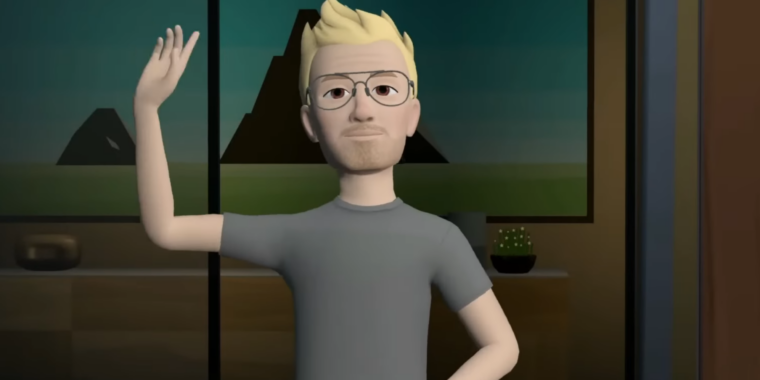
Carmack’s vision didn’t come to pass Tuesday, as a jerky and awkward Carmack avatar gave one of his signature, hour-long unscripted talks amid a deserted VR space, broadcast out as plain old 2D video on Facebook.
“Last year I said that I’d be disappointed if we weren’t having Connect in Horizon this year,” Carmack said by way of introduction. “This here, this isn’t really what I meant. Me being an avatar on-screen on a video for you is basically the same thing as [just] being on a video.”
That set the tone for a presentation in which Carmack said that “there’s a bunch that I’m grumpy about” regarding the current state of Meta’s current VR hardware and software. While that grumpiness was somewhat tempered with talk of recent improvements and hope for the future of virtual reality, Carmack seemed generally frustrated with the direction Meta as a whole is taking its VR efforts.
Pushing for quantity over quality
Take Horizon Worlds, for instance, Meta’s premiere product for socializing in the company’s version of the metaverse. On the one hand, Carmack said watching Mark Zuckerberg’s Connect presentation in a Horizon room alongside a few dozen other people Tuesday offered “some genuine benefits” over watching that same presentation on a laptop screen amid his cluttered desk.
On the other hand, that’s a far cry from his vision for “arena scale support with thousands of avatars milling around… at least hundreds in large rooms… in a completely uniformly shared world.” Carmack said he wants “to be present with a live audience in a virtual space where everyone who wanted to could stay afterwards and talk as long as they felt like it.”
“Last year I said that I’d be disappointed if we weren’t having Connect in Horizon this year… This here, this isn’t really what I meant.”
Former Oculus CTO John Carmack
If you could achieve a truly virtual conference space like that, “You could just give people a free headset and still come out ahead” compared to the hassle of putting on an in-person conference, Carmack said. That kind of broadly shared world is a difficult technical challenge, Carmack said, and while Horizon “definitely can’t handle it now… it’s not an insurmountable [challenge].”
Carmack also mentioned some “public mockery about avatar quality earlier this year,” a seeming reference to a low-detail Mark Zuckerberg avatar that went viral in August after Meta shared it online. That reaction has caused “a lot of people internally [to be] paranoid about showing anything but the highest quality avatars.”
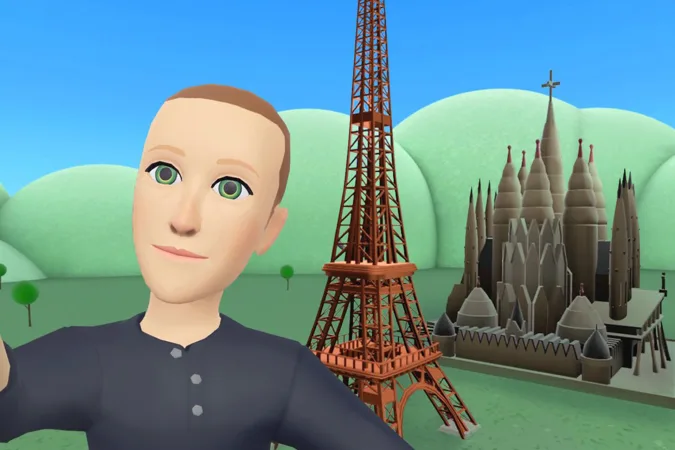
But Carmack expressed some heavy skepticism at that push for avatar fidelity. He expressed a preference for spaces filled with a lot of low-detail avatars to Meta’s push for the kind of nearly photorealistic “codec avatars” that eat up too much processor power to allow for crowded virtual rooms. “We’ve got a finite amount of resources on our headsets here, and cloud rendering won’t save us in many cases,” Carmack said. “I definitely lean towards optimizing for quantity and not quality.”
And while Carmack said he was happy with the current state of Meta’s avatars, he noted that his Connect presentation was taking place in a “custom build of Horizon” designed to guarantee the level of detail on his avatar never dropped. He also turned off the much-ballyhooed face tracking features on his Quest Pro headset because, in the software’s current state, “there’s at least a decent chance that I would do something very embarrassing looking” in a very public setting.


