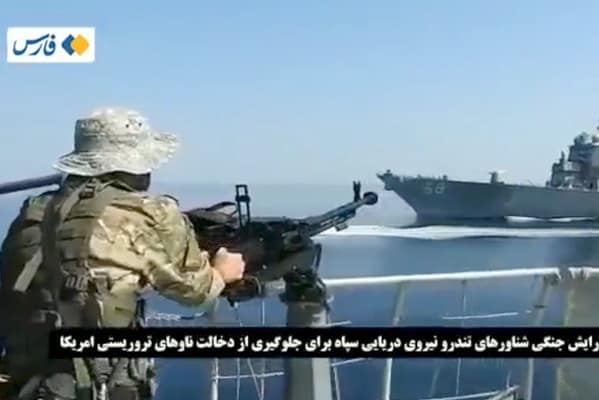
Iran will not reopen the strategic Strait of Hormuz, despite warnings from Donald Trump, according to a former commander of the Islamic Revolutionary Guard Corps (IRGC).
The ex-IRGC official stated that Tehran intends to maintain pressure on global shipping through this narrow waterway, which accounts for roughly one-fifth of the world’s oil supplies.
Trump had warned Iran that if it continued to interfere with vessels in the strait, he would reconsider his decision not to destroy energy infrastructure on Kharg Island.
Kharg Island is crucial to Iran’s economy, handling approximately 90% of the country’s oil exports.
This latest exchange of threats underscores the increasing risk of escalation in the Gulf, as tensions between Iran and the United States rise over the blockade of this strategic waterway and attacks on shipping.
“Without America leaving the Persian Gulf and control of the Strait of Hormuz being in the hands of the regional countries and Oman, security cannot be achieved,” former IRGC officer Mohsen Rezaei said.
He added that Tehran will consider ending the war only when compensation from the US with a “100% guarantee about the future, which is impossible without America leaving the Persian Gulf”.
On Friday the US Department of Defence announced they are deploying an additional 5,000 Marines and warships to the Middle East in response to escalating Iranian attacks around the Strait of Hormuz, according to The Wall Street Journal.
U.S. officials confirmed that this deployment includes an amphibious ready group and a Marine expeditionary unit, which typically consists of several naval vessels and approximately 5,000 Marines.
Among the ships reportedly heading to the region is the amphibious assault ship USS Tripoli (LHA-7), along with its associated Marine units.
This deployment was authorised following a request from the United States Central Command, as Iranian attacks on shipping have intensified in and around the Strait, a critical maritime corridor through which around 20% of the world’s oil supply usually passes.
The reinforcement aims to protect commercial shipping and energy supplies, prepare for potential naval escort missions for oil tankers, and enhance U.S. military deterrence in the Gulf.
However, officials caution that full escort operations may not commence immediately due to the high threat posed by Iranian missiles, drones, and potential sea mines.
This military buildup is part of the largest U.S. military concentration in the region in years, with carrier strike groups, fighter aircraft, and missile-defence systems already deployed across the Gulf and surrounding areas amid rising tensions with Iran.
By sending Marines and amphibious warships, the U.S. gains the capability to escort commercial oil tankers through the strait. This strategy is akin to previous operations where U.S. warships accompany tankers through hazardous waters to deter attacks from missiles, drones, or fast boats launched by the Islamic Revolutionary Guard Corps naval forces.


