Interest is growing rapidly
“The amount of momentum from heavyweights in the tech industry is very much worth paying attention to,” said Caleb Henry, director of research at Quilty Space, in an interview. “If they start putting money behind it, we could see another transformation of what’s done in space.”
The essential function of a data center is to store, process, and transmit data. Historically, satellites have already done a lot of this, Henry said. Telecommunications satellites specialize in transmitting data. Imaging satellites store a lot of data and then dump it when they pass over ground stations. In recent years, onboard computers have gotten more sophisticated at processing data. Data centers in space could represent the next evolution of that.
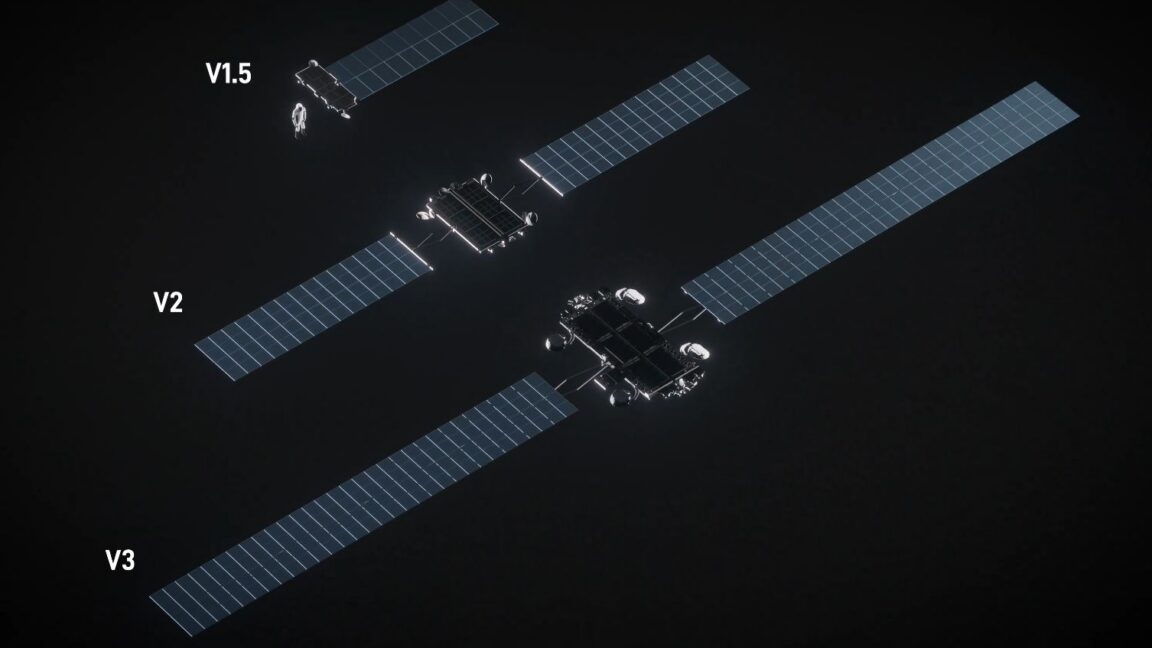
Critics rightly note that it would require very large satellites with extensive solar panels to power data centers that rival ground-based infrastructure. However, SpaceX’s Starlink V3 satellites are unlike any previous space-based technology, Henry said.
A lot more capacity
SpaceX’s current Starlink V2 mini satellites have a maximum downlink capacity of approximately 100 Gbps. The V3 satellite is expected to increase this capacity by a factor of 10, to 1 Tbps. This is not unprecedented in satellite capacity, but it certainly is at scale.
For example, Viasat contracted with Boeing for the better part of a decade, spending hundreds of millions of dollars, to build Viasat-3, a geostationary satellite with a capacity of 1 Tbps. This single satellite may launch next week on an Atlas V rocket.
SpaceX plans to launch dozens of Starlink V3 satellites—Henry estimates the number is about 60—on each Starship rocket launch. Those launches could occur as soon as the first half of 2026, as SpaceX has already tested a satellite dispenser on its Starship vehicle.
“Nothing else in the rest of the satellite industry that comes close to that amount of capacity,” Henry said.
Exactly what “scaling up” Starlink V3 satellites might look like is not clear, but it doesn’t seem silly to expect it could happen. The very first operational Starlink satellites launched a little more than half a decade ago with a mass of about 300 kg and a capacity of 15Gbps. Starlink V3 satellites will likely mass 1,500 kg.


