
[ad_1]
According to DeDeo, the idea was to examine the question of cultural evolution on a population level, rather than on the individual level: “How do these individual things agglomerate to produce the culture? “
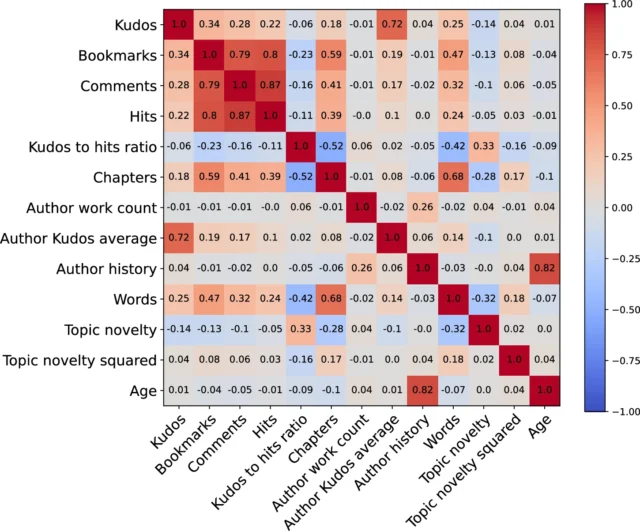
Strong positive correlation is found between the response variables except for the Kudos-to-hits ratio. Topic novelty is weakly positively correlated with Kudos-to-hits ratio but negatively correlated with the other response variables.
Credit:
E. Jing et al., 2025
The results were striking. AO3 members overwhelmingly preferred familiarity in their fan fiction, i.e., more of the same. One notable exception was a short story that was both hugely popular and highly novel. Simply titled “I Am Groot,” the story featured the character from Guardians of the Galaxy. The text is just “I am Groot” repeated 40,000 times—a stroke of genius in that this is entirely consistent with the canonical MCU character, whose entire dialogue consists of those words, with meaning conveyed by shifts of tone and context. But such exceptions proved to be very rare.
“We were so stunned that balance theory wasn’t working,” said DeDeo, who credits Jing with the realization that they were dealing with two distinct pieces of the puzzle: how much is being consumed, and how much people like what they consume, i.e., enjoyment. Their analysis revealed, first, that people really don’t want an optimized mix of familiar and new; they want the same thing over and over again, even within the fanfic community. But when people do make the effort to try something new, they tend to enjoy it more than just consuming more of the same.
In short, “We are anti-balance theory,” said DeDeo. “In biology, for example, you make a small variation in the species and you get micro-evolution. In culture, a minor variation is just less likely to be consumed. So it really is a mystery how we evolve at all culturally; it’s not happening by gradual movement. We can see that there’s novelty. We can see that when people encounter novelty, they enjoy it. But we can’t quite make sense of how these two competing effects work out.”
[ad_2]
Source link


