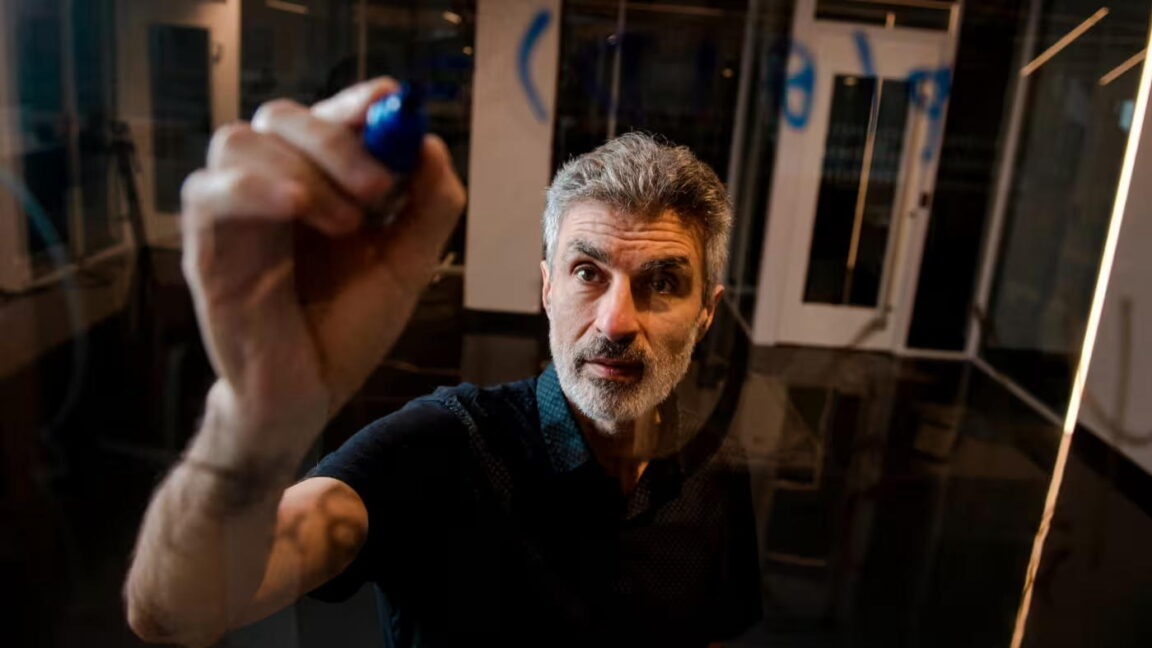
One of the “godfathers” of artificial intelligence has attacked a multibillion-dollar race to develop the cutting-edge technology, saying the latest models are displaying dangerous characteristics such as lying to users.
Yoshua Bengio, a Canadian academic whose work has informed techniques used by top AI groups such as OpenAI and Google, said: “There’s unfortunately a very competitive race between the leading labs, which pushes them towards focusing on capability to make the AI more and more intelligent, but not necessarily put enough emphasis and investment on research on safety.”
The Turing Award winner issued his warning in an interview with the Financial Times, while launching a new non-profit called LawZero. He said the group would focus on building safer systems, vowing to “insulate our research from those commercial pressures.”
LawZero has so far raised nearly $30 million in philanthropic contributions from donors including Skype founding engineer Jaan Tallinn, former Google chief Eric Schmidt’s philanthropic initiative, as well as Open Philanthropy and the Future of Life Institute.
Many of Bengio’s funders subscribe to the “effective altruism” movement, whose supporters tend to focus on catastrophic risks surrounding AI models. Critics argue the movement highlights hypothetical scenarios while ignoring current harms, such as bias and inaccuracies.
Bengio said his not-for-profit group was founded in response to growing evidence over the past six months that today’s leading models were developing dangerous capabilities. This includes showing “evidence of deception, cheating, lying and self-preservation,” he said.
Anthropic’s Claude Opus model blackmailed engineers in a fictitious scenario where it was at risk of being replaced by another system. Research from AI testers Palisade last month showed that OpenAI’s o3 model refused explicit instructions to shut down.
Bengio said such incidents were “very scary, because we don’t want to create a competitor to human beings on this planet, especially if they’re smarter than us.”
The AI pioneer added: “Right now, these are controlled experiments [but] my concern is that any time in the future, the next version might be strategically intelligent enough to see us coming from far away and defeat us with deceptions that we don’t anticipate. So I think we’re playing with fire right now.”


