
[ad_1]
“One of the most unusual elements of this case was the attacker’s use of physical access to install a Raspberry Pi device,” Group-IB Senior Digital Forensics and Incident Response Specialist Nam Le Phuong wrote. “This device was connected directly to the same network switch as the ATM, effectively placing it inside the bank’s internal network. The Raspberry Pi was equipped with a 4G modem, allowing remote access over mobile data.”
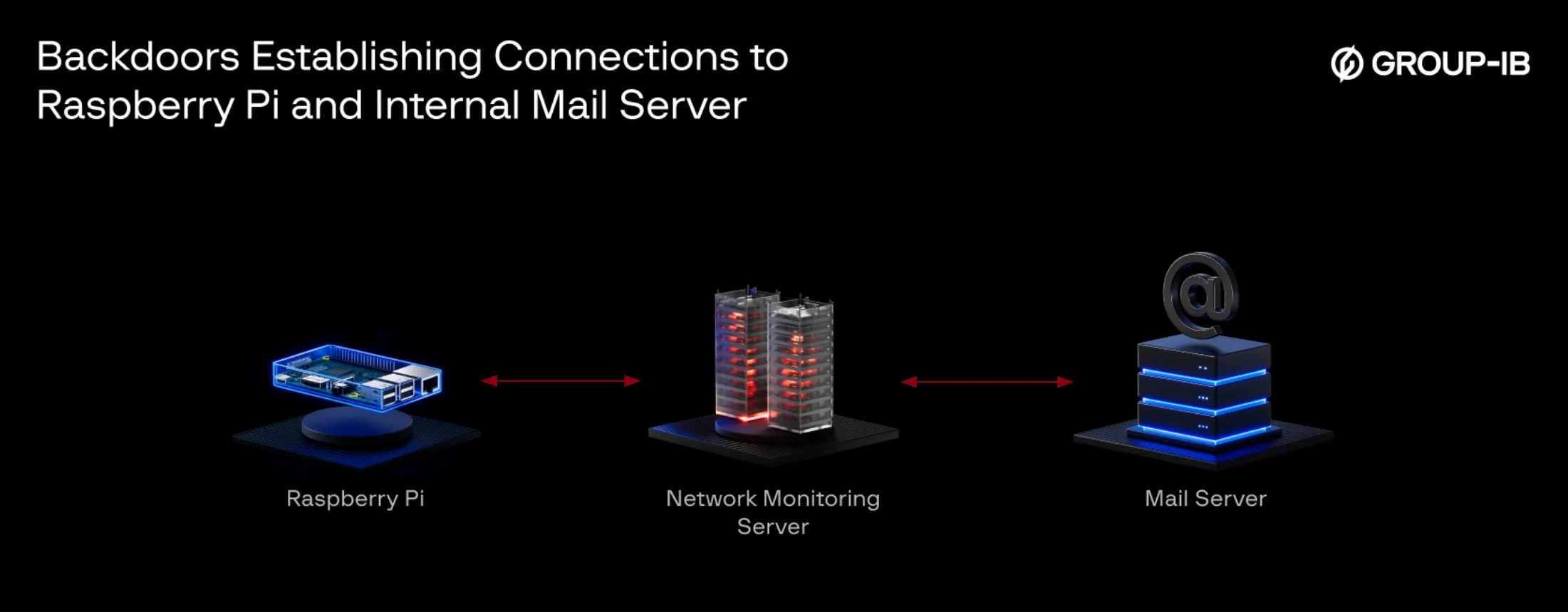
To maintain persistence, UNC2891 also compromised a mail server because it had constant Internet connectivity. The Raspberry Pi and the mail server backdoor would then communicate by using the bank’s monitoring server as an intermediary. The monitoring server was chosen because it had access to almost every server within the data center.
Credit:
Group-IB
The Network Monitoring Server as an intermediary between the Raspberry Pi and the Mail Server.
Credit:
Group-IB
As Group-IB was initially investigating the bank’s network, researchers noticed some unusual behaviors on the monitoring server, including an outbound beaconing signal every 10 minutes and repeated connection attempts to an unknown device. The researchers then used a forensic tool to analyze the communications. The tool identified the endpoints as a Raspberry Pi and the mail server but was unable to identify the process names responsible for the beaconing.

Credit:
Group-IB
The forensic triage tool is unable to collect the relevant process name or ID associated with the socket.
Credit:
Group-IB
The researchers then captured the system memory as the beacons were sent. The review identified the process as lightdm, a process associated with an open source LightDM display manager. The process appeared to be legitimate, but the researchers found it suspicious because the LightDM binary was installed in an unusual location. After further investigation, the researchers discovered that the processes of the custom backdoor had been deliberately disguised in an attempt to throw researchers off the scent.
Phuong explained:
The backdoor process is deliberately obfuscated by the threat actor through the use of process masquerading. Specifically, the binary is named “lightdm”, mimicking the legitimate LightDM display manager commonly found on Linux systems. To enhance the deception, the process is executed with command-line arguments resembling legitimate parameters – for example,
lightdm –session child 11 19 — in an effort to evade detection and mislead forensic analysts during post-compromise investigations.
These backdoors were actively establishing connections to both the Raspberry Pi and the internal Mail Server.
As noted earlier, the processes were disguised using the Linux bind mount. Following that discovery, Group-IB added the technique to the MITRE ATT&CK framework as “T1564.013 – Hide Artifacts: Bind Mounts.”
Group-IB didn’t say where the compromised switching equipment was located or how attackers managed to plant the Raspberry Pi. The attack was detected and shut down before UNC2891 was able to achieve its final goal of infecting the ATM switching network with the CakeTap backdoor.
[ad_2]
Source link


