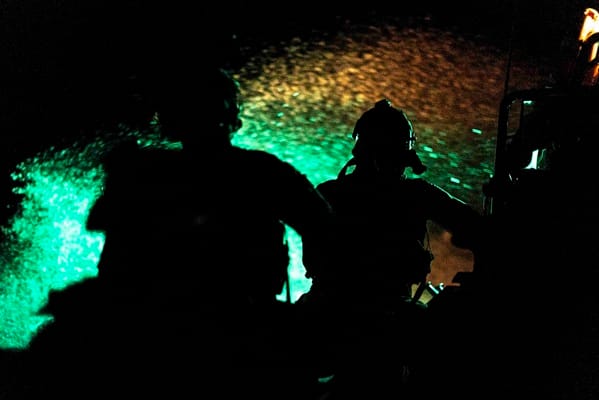
The recovery of a downed U.S. airman in Iran has been described by officials as one of the most complex and high-risk rescue operations in recent military history — a two-day mission carried out deep within hostile territory under constant threat of interception.
The operation focused on the crew of an F-15E Strike Eagle shot down over Iran. While the pilot was rescued fairly quickly, the navigator remained isolated for nearly 48 hours — prompting an urgent, large-scale recovery effort.
According to reports from The New York Times, The Wall Street Journal, and CNN, the navigator managed to make contact with U.S. forces shortly after ejecting, but sustained injuries that complicated extraction.
From that moment, the mission became a race against time.
American planners faced a shrinking window to find and extract the airman before Iranian forces could reach him — a scenario that could have ended in capture, or worse.
The scale of the response underscores the stakes involved.
Read more related news:
Iran has no leadership as Mojtaba Khamenei likely suffered amputations and brain injuries
Missing US pilot rescued after ‘heavy firefight’ inside Iran
Hundreds of special operations personnel were deployed, supported by dozens of aircraft, including helicopters, drones, and fixed-wing platforms. The mission also utilised a full range of U.S. capabilities — intelligence, cyber operations, and space-based surveillance.
Among the assets utilised were MQ-9 Reaper drones, which were reportedly assigned to target Iranian forces that approached the navigator’s location.
This integration of kinetic and intelligence abilities exemplifies how combat search and rescue has evolved into a highly networked, multi-domain operation, no longer a standalone mission.
One of the more striking elements of the mission was the reported use of deception.
According to Fox News and The Wall Street Journal, the Central Intelligence Agency carried out a disinformation campaign within Iran, disseminating false narratives that the navigator had already been recovered.
The aim was straightforward: to delay and mislead Iranian search efforts sufficiently for U.S. forces to finish the extraction.
If accurate, it emphasises the growing importance of information warfare — not only in shaping public perception but also in directly influencing battlefield results.
The physical environment added another layer of risk.
Retired U.S. Air Force Colonel Cedric Leighton observed that terrain, weather conditions, and limited landing zones could have all contributed to the mission’s failure.
Remote mountainous areas, dust, and low visibility complicate aviation operations — especially when aircraft must fly at low altitude and under threat from enemy air defences.
Every phase of the mission — insertion, location, protection, and extraction — demanded precise coordination under pressure.
There are indications that the operation was not conducted in isolation. Reports suggest that Israel provided intelligence support, assisting in tracking Iranian movements and helping counter potential aerial threats during the 36-hour operation. While this cooperation has not been officially confirmed, it aligns with the increasing military coordination between Washington and Tel Aviv amid the wider regional conflict.
The mission came with its costs. According to The Wall Street Journal, two MC-130J Commando II aircraft encountered issues on the ground and were deliberately destroyed to prevent them from falling into Iranian hands. Valued at over $100 million each, their destruction underscores both the intensity of the operation and the lengths to which U.S. forces were willing to go to protect sensitive technology.
Iranian media later released images of the wreckage, providing a rare visual reminder of the risks involved in penetrating hostile airspace. In the end, all U.S. personnel involved were successfully extracted from Iranian airspace, bringing the mission to a close.
Officials have since described it as one of the most complex personnel recovery operations in recent history—a benchmark for modern special operations.
The operation combined several elements:
- Real-time intelligence
- Precision strike capability
- Cyber and information warfare
- Allied coordination
- High-risk aviation under hostile conditions
Beyond the immediate success, the operation sends a broader message. It demonstrates the United States’ ability—and willingness—to project power deep into adversary territory to recover its personnel, even under extreme conditions.
However, it also highlights the escalating risks of the wider conflict. Missions of this scale do not occur in isolation; they indicate how close major powers are to direct confrontation and how quickly a single incident can escalate into something far more dangerous.


