[ad_1]

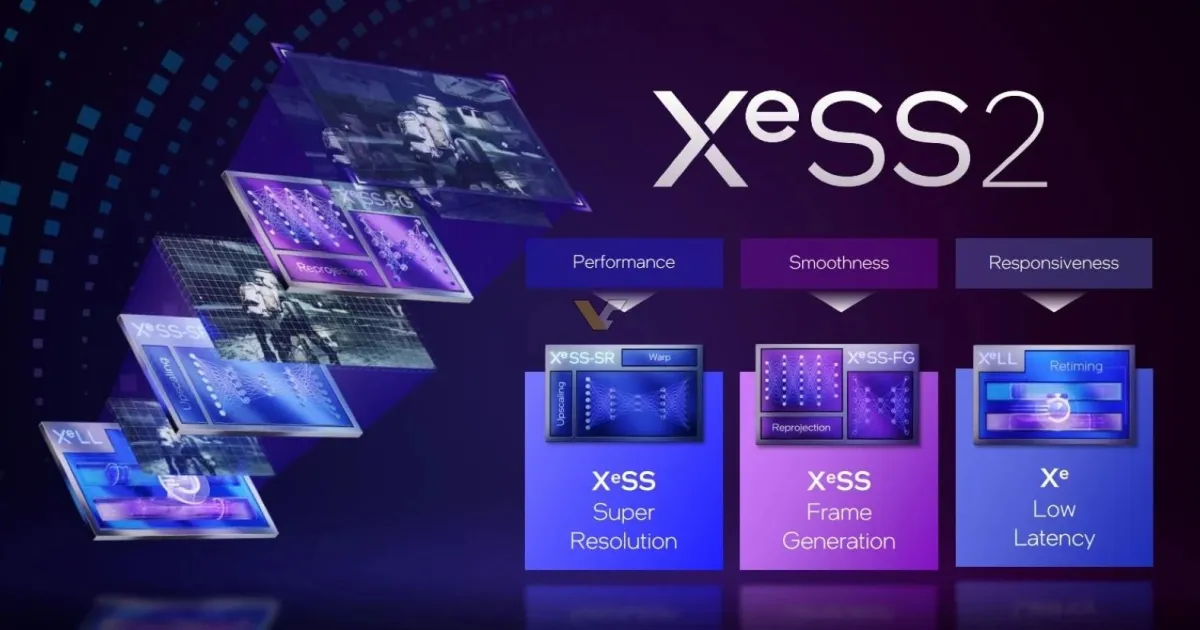
Intel has finally released the XeSS 2.0 Software Development Kit (SDK) to aid game development through upscaling, frame generation, and latency reduction technologies. The SDK is now accessible via Intel’s GitHub repository, providing developers with pre-built tools for integrating XeSS into their projects.
Intel expanded its suite of XeSS technologies last year when it unveiled its budget segment GPUs, the Arc B580 and B570. The XeSS 2.0 SDK introduces three main components: XeSS-SR for AI-driven super resolution, XeSS-FG for frame generation, and XeLL for low-latency improvements. These advancements position XeSS 2.0 as a competitor to Nvidia’s DLSS (Deep Learning Super Sampling) and AMD’s FSR (FidelityFX Super Resolution), offering similar AI-powered enhancements to image quality and performance. Intel has also updated the XeSS inspector tool to support Vulkan and DirectX 11, making it easier for developers to optimize game performance across multiple rendering APIs.
To help with integration, Intel has developed plugins for widely used game engines, including Unreal Engine and Unity. However, despite these efforts to make the SDK more accessible, Intel’s decision to keep XeSS 2.0 closed-source limits its flexibility compared to AMD’s open-source FSR.
As spotted by Tom’s Hardware, the licensing agreement prohibits reverse engineering, decompilation, or disassembly, preventing developers from modifying or extending its capabilities beyond what Intel provides. This approach means that developers must work with pre-compiled binaries, which could impact broader adoption, particularly among studios seeking greater control over their graphics pipelines.
Additionally, XeSS 2.0 remains a Windows-first technology, restricting its immediate availability on other platforms. While Intel has not ruled out future cross-platform support, its current design prioritizes Windows-based gaming environments. The technology has yet to see widespread adoption, with only a handful of titles currently supporting XeSS 2.0. Intel has acknowledged this limitation and is actively working with game developers to expand the presence of XeSS in upcoming releases.
[ad_2]
Source link


