[ad_1]
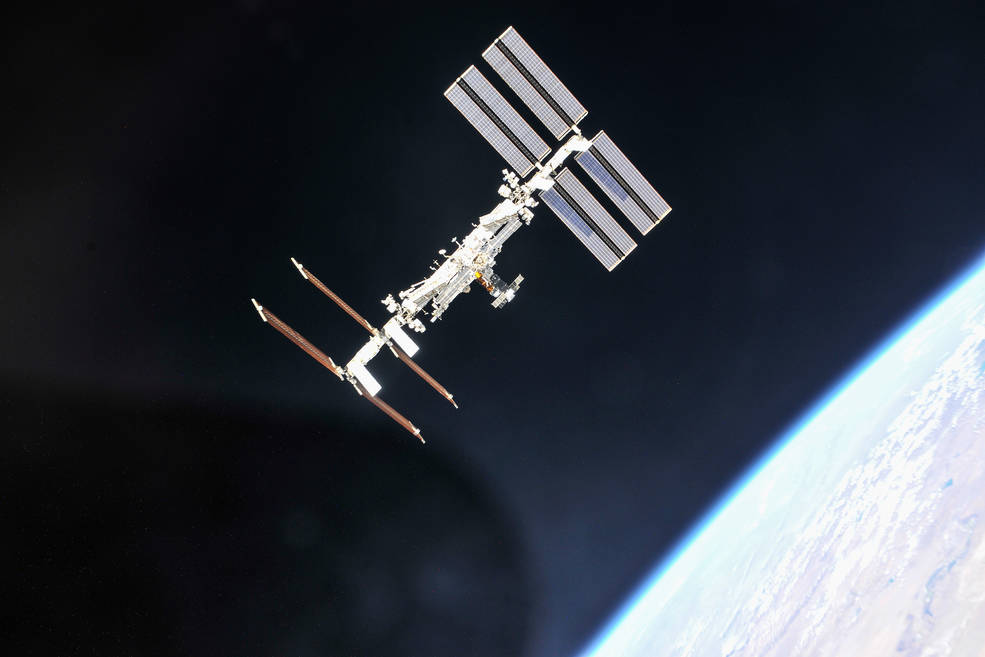
International Space Station (ISS) inhabitant Samantha Cristoforetti has been talking about the threat that space debris poses to the orbital outpost.
With the ISS orbiting Earth at more than 17,000 mph, and with plenty of space junk doing the very same thing, there’s certainly a risk of a Gravity-style calamity occurring, though fortunately during the station’s 20-year history a serious event has yet to occur.
In a video shared with her half a million TikTok followers and one million Twitter fans, Italian astronaut Cristoforetti explained this week that much of the exterior of the station is covered with panels that serve as shields protecting the ISS from micrometeorites and tiny pieces of space debris, while the rest of it comprises super-strong fused-silica and borosilicate-glass windows.
“Is the International Space Station protected from micrometeorites and space debris?” #AskMe #SpaceDebris #MissionMinerva@esa @esaspaceflight @Space_Station pic.twitter.com/boHmUxH2DI
— Samantha Cristoforetti (@AstroSamantha) September 8, 2022
Cristoforetti, who arrived at the space station in April for a six-month stay, said that if a tiny object did breach the ISS’s defenses, it would likely cause a leak, resulting in air flowing from the station into space. The loss of pressure could happen so slowly that the astronauts wouldn’t even realize at first. That’s why the station includes a Rapid Depressurization Emergency Alarm.
Detecting a potentially dangerous drop in pressure, the alarm would alert the crew to the situation. Investigating astronauts can then use different tools to try to locate the leak before fixing it.
“If that doesn’t work — maybe because the leak is very small and so the air flow is very weak — we start closing the hatches, module by module,” Cristoforetti explains in the video. “Once a hatch is closed, you can check the pressure using a portable pressure gauge. If the pressure stabilizes it means that you have determined that the leak was on the other side of the [closed] hatch.”
Such an incident occurred in 2020 when astronauts had trouble finding the source of a small leak on the station. After searching for more than a month, the leak was discovered inside Russia’s Zvezda service module.
While Cristoforetti talks mainly about tiny fragments floating through space, there are also some pretty large pieces of space debris orbiting Earth, too. These old rocket parts or decommissioned satellites pose a much greater risk to the ISS. Fortunately, there are teams on the ground monitoring such hazards, and if a piece is detected heading toward the station, it’s directed to raise or lower its orbit to avoid a potentially disastrous collision.
Occasionally, however, there’s little time to take evasive action. Just last year, for example, ISS astronauts were ordered to take shelter inside the station’s docked spacecraft as a cloud of junk came perilously close. On that occasion the ISS escaped damage, but the event was a reminder of the kind of risks astronauts take when traveling in space.
Editors’ Recommendations
[ad_2]
Source link


