
[ad_1]
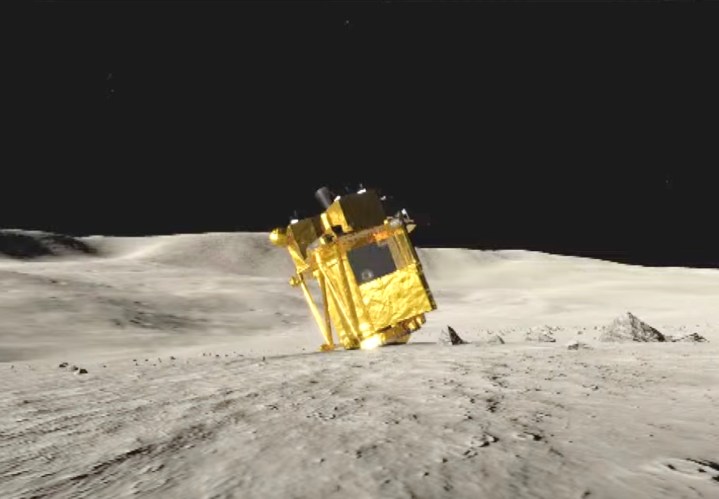
Japan’s lunar lander is back in touch with its team on Earth after regaining power via is solar panels.
The Smart Lander for Investigating Moon (SLIM) reached the moon on January 19, making Japan only the fifth country to achieve the feat.
But during the final stages of its descent, the uncrewed, robotic lander lost its way and ended up tumbling over. Its battery offered a few hours of power but when that ran out, the lander went quiet. At the time, officials at Japan’s space agency, JAXA, said there was a chance that SLIM could power up again once sunlight fell onto the lander’s solar panels.
On Sunday, JAXA announced it had reestablished contact with its lander and even received images taken by its onboard camera.
“Communication with SLIM was successfully established last night, and operations resumed!” JAXA said in a post on social media. “Science observations were immediately started with the MBC [multi-band camera].”
A message on its website showed one of the images (below) that included labels for various nearby rocks, including one called “toy poodle,” presumably for its perceived likeness to the animal.

SLIM’s success in powering up again is clearly a major breakthrough for JAXA, though it’s not yet clear what this means for the mission going forward. In the immediate future, preparation is underway to carry out “high-resolution spectroscopic observations” once the solar illumination condition improves and SLIM recovers by the power generated by the solar array, JAXA said.
Other mission successes include SLIM’s deployment of two tiny rovers called Lunar Excursion Vehicle 1 (LEV-1) and Sora-Q.
However, the main purpose of the mission was to demonstrate new technology for precision landings, and although its descent didn’t go as planned, data suggested that SLIM’s touchdown accuracy could be considered as being within 32.8 feet (10 meters), possibly even 9.8 feet (3 meters), making it way more accurate than technology used by earlier lunar missions, which targeted landing zones spanning several miles.
The technology could see future lunar missions landing in locations with much rougher terrain. This could include touchdowns in places closer to areas believed to hold water ice, a resource that NASA hopes can be converted to rocket fuel for launches from the lunar surface to Mars and beyond.
Editors’ Recommendations
[ad_2]
Source link


