[ad_1]
Among other things, the James Webb Space Telescope is designed to get us closer to finding habitable worlds around faraway stars. From its perch a million miles from Earth, Webb’s huge gold-coated mirror collects more light than any other telescope put into space.
The Webb telescope, launched in 2021 at a cost of more than $10 billion, has the sensitivity to peer into distant planetary systems and detect the telltale chemical fingerprints of molecules critical to or indicative of potential life, like water vapor, carbon dioxide, and methane. Webb can do this while also observing the oldest observable galaxies in the Universe and studying planets, moons, and smaller objects within our own Solar System.
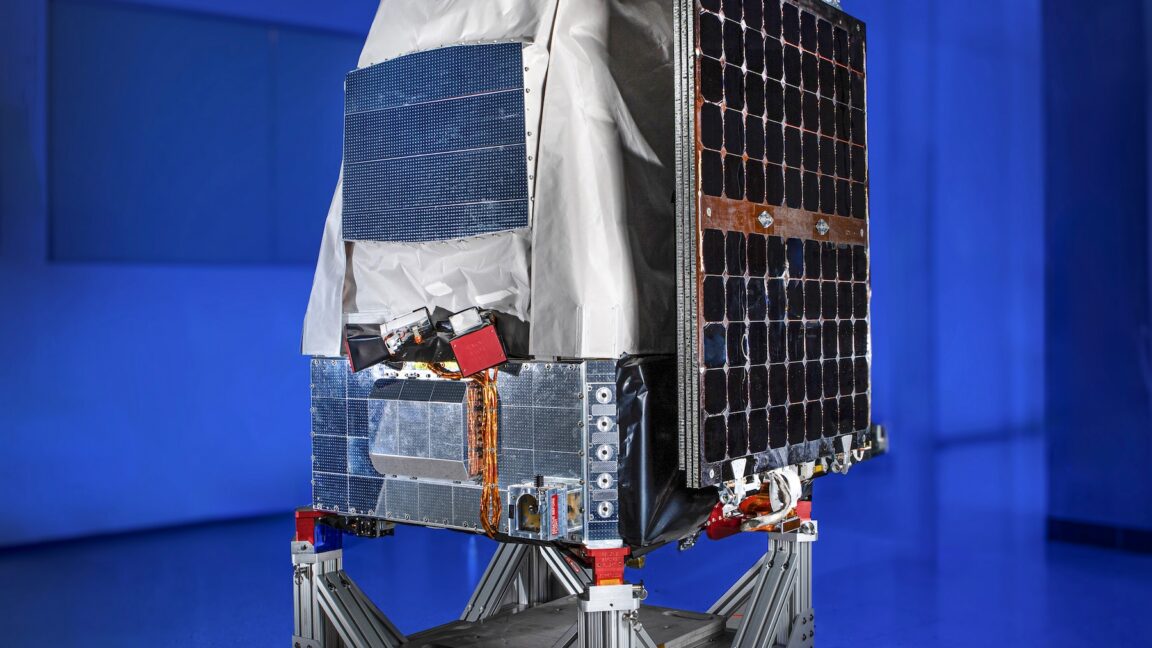
Naturally, astronomers want to get the most out of their big-budget observatory. That’s where NASA’s Pandora mission comes in.
The Pandora satellite rocketed into orbit early Sunday from Vandenberg Space Force Base, California. It hitched a ride with around 40 other small payloads aboard a SpaceX Falcon 9 rocket, launching into a polar Sun-synchronous orbit before deploying at an altitude of roughly 380 miles (613 kilometers).
Over the next few weeks, ground controllers will put Pandora through a series of commissioning and calibration steps before turning its eyes toward deep space. Pandora is a fraction of the size of Webb. Its primary mirror is about the size of the largest consumer-grade amateur telescopes, less than one-tenth the dimension of Webb’s. NASA capped Pandora’s budget at $20 million. The budget to develop Webb was more than 500 times higher.
Double-checking Webb
So what can little Pandora add to Webb’s bleeding-edge science? First, it helps to understand how scientists use Webb to study exoplanets. When a planet passes in front of its parent star, some of the starlight shines through its atmosphere. Webb has the sensitivity to detect the filtered starlight and break it apart into its spectral components, telling astronomers about the composition of clouds and hazes in the planet’s atmosphere. Ultimately, the data is useful in determining whether an exoplanet might be like Earth.
[ad_2]
Source link


