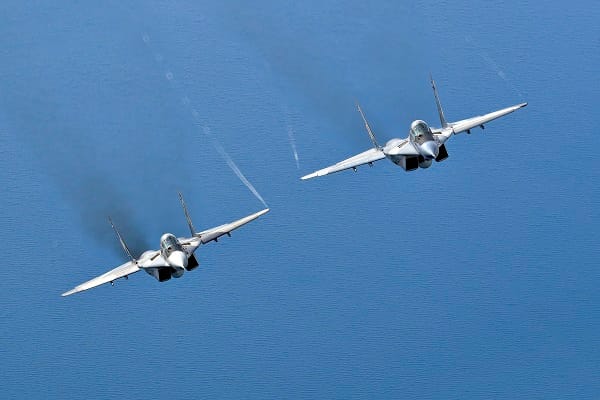
The European security alarm reached its highest level in years after Polish forces scrambled warplanes overnight following a huge Russian strike on Ukraine.
The Operational Command of the Polish Armed Forces activated air defence assets as long-range aviation units from the Russian Aerospace Forces launched coordinated attacks across Ukrainian territory.
Fighter jets, surveillance aircraft and air defence batteries were placed on alert along the eastern border of the North Atlantic Treaty Organization (NATO).
Polish operational commander Rajmund Andrzejczak authorised the precautionary deployment of combat air patrol fighters, early warning radar aircraft, surface-to-air defence missile units, and strategic monitoring networks.
Officials stressed the mission was defensive, but military sources warned that the scale of Russian long-range activity required continuous readiness.
The capital Kyiv was struck repeatedly overnight.
Reports described ballistic missile explosions around 04:00–04:30 local time, with a high-rise building fire after impact.
Nationwide air raid alerts were in place as drones and missiles approached the Ukrainian capital.
Russian strike groups were detected entering Ukrainian airspace from multiple directions.
Monitoring channels indicated that Russia was preparing to launch advanced weapons systems, including platforms such as the 3M22 Zircon hypersonic missiles and Kh-47M2 Kinzhal jets, highlighting the potential for increased escalation and the need for strategic preparedness.
Observed platforms reportedly included Tupolev Tu-95MS strategic bomber fleets, Tupolev Tu-160 nuclear-capable strike aircraft, 3M22 Zircon reportedly fired from Black Sea positions and Kh-47M2 Kinzhal carrier jets.
Some intelligence tracking channels warned that launch manoeuvres could have produced missile arrivals near Kyiv around 06:00.
Western defence planners are watching closely for any spill over effects near alliance territory, which could threaten NATO members and necessitate coordinated response strategies.
Military analysts warn that continued long-range missile barrages increase the risk of drone navigation errors entering NATO airspace, electronic warfare interference, and accidental cross-border incidents.
So far, the alliance has avoided direct engagement in the war.
Security officials say Polish air operations will remain active while Russian strikes continue.
The situation is being treated as a potential precursor to wider regional escalation rather than an immediate declaration of broader conflict.


