[ad_1]
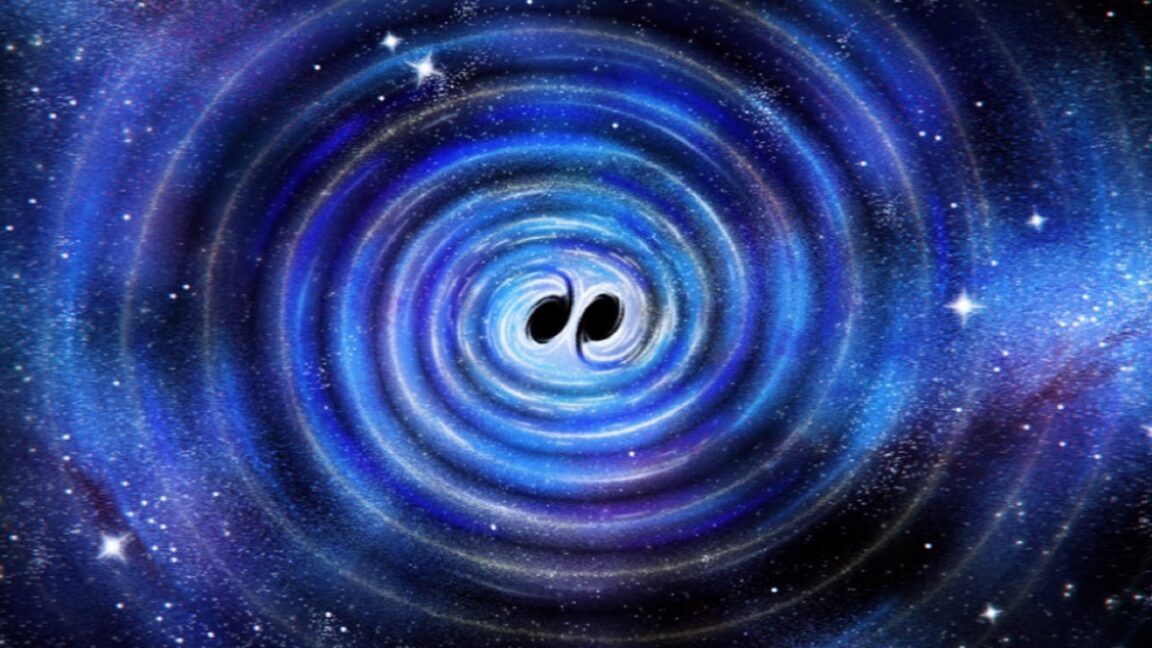
But the final reverberations as the newly formed black hole settled into its new state, aka the ringdown, from that first event were significantly fainter, and scientists were unable to distinguish between the ringing from the initial collision and the ringdown. For GW250114, LIGO’s improved sensitivity meant that scientists could measure the frequency and duration of the merged black hole’s ringdown much more precisely. The resulting analysis bolsters the 2019 results confirming the “no hair” theorem.
Audio comparison of the 2015 and 2025 gravitational wave signals. Credit: LIGO/Virgo/KAGRA
With the latest event, physicists obtained an “exquisitely detailed view of the signal both before and after the black hole merger,” said co-author Maximiliano Isi of Columbia University, who led a 2021 study using the same method on the 2015 data to observationally confirm Hawking’s area theorem. As with the no-hair theorem, the clearer signal from GW250114 further bolsters that earlier result. The GW250114 data revealed that the two initial black holes had a total surface area of about 240,000 square kilometers, about the size of the United Kingdom. After the merger, the new black hole was about 400,000 square kilometers, about the size of Sweden.
“Even though it’s a very simple statement—’areas can only increase’—it has immense implications,” said Isi. Notably, Hawking and Jacob Bekenstein later showed that a black hole’s area is proportional to its entropy, which also must increase per the second law of thermodynamics. This is a key element in ongoing attempts to develop a quantum theory of gravity. “It’s really profound that the size of a black hole’s event horizon behaves like entropy,” said Isi. “It means that some aspects of black holes can be used to mathematically probe the true nature of space and time.”
Caltech physicist Kip Thorne, a longtime friend of Hawking, recalled that when LIGO detected its first gravitational wave signature, Hawking called and asked him if the collaboration would be able to test his theorem. Hawking died in 2018. “If [he] were alive, he would have reveled in seeing the area of the merged black holes increase,” said Thorne.
Physical Review Letters, 2025. DOI: 10.1103/kw5g-d732 (About DOIs).
[ad_2]
Source link


