[ad_1]
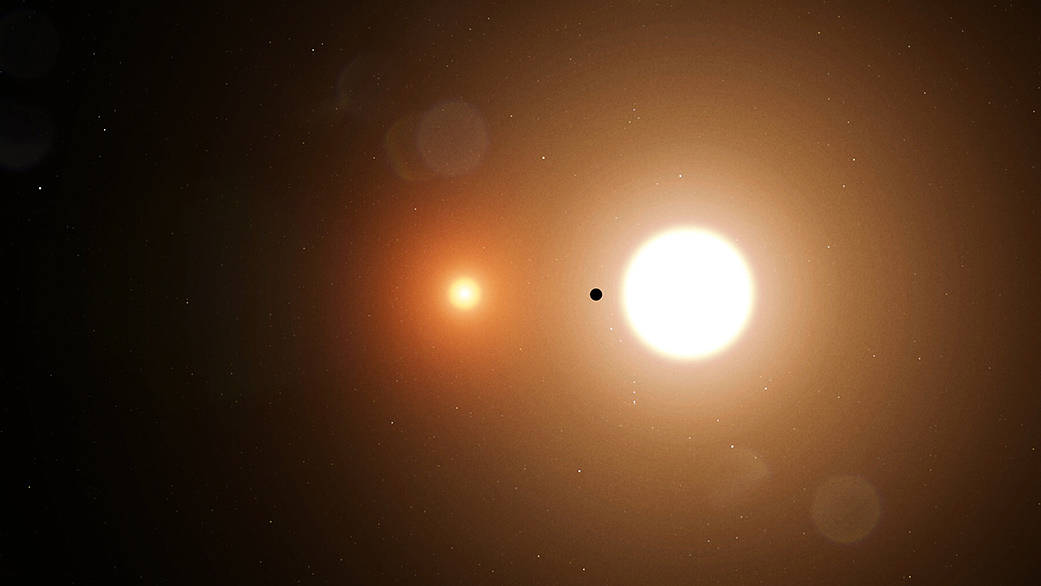
And, critically, the entire orbit is within the orbit of the smaller companion star. The gravitational forces of a tight binary should prevent any planets from forming within this space early in the system’s history. So, how did the planet end up in such an unusual configuration?
A confused past
The fact that one of the stars present in ν Octantis is a white dwarf suggests some possible explanations. White dwarfs are formed by Sun-like stars that have advanced through a late helium-burning period that causes them to swell considerably, leaving the outer surface of the star weakly bound to the rest of its mass. At the distances within ν Octantis, that would allow considerable material to be drawn off the outer companion and pulled onto the surface of what’s now the central star. The net result is a considerable mass transfer.
This could have done one of two things to place a planet in the interior of the system. One is that the transferred material isn’t likely to make an immediate dive onto the surface of the nearby star. If the process is slow enough, it could have produced a planet-forming disk for a brief period—long enough to produce a planet on the interior of the system.
Alternatively, if there were planets orbiting exterior to both stars, the change in the mass distribution of the system could have potentially destabilized their orbits. That might be enough to cause interactions among the planets to send one of them spiraling inward, where it was eventually captured in the stable retrograde orbit we now find it.
Either case, the authors emphasize, should be pretty rare, meaning we’re unlikely to have imaged many other systems like this at this stage of our study of exoplanets. They do point to another tight binary, HD 59686, that appears to have a planet in a retrograde orbit. But, as with ν Octantis, the data isn’t clear enough to rule out alternative configurations yet. So, once again, more data is needed.
Nature, 2025. DOI: 10.1038/s41586-025-09006-x (About DOIs).
[ad_2]
Source link


