[ad_1]
“There are, surprisingly, a lot of trucks today that are standing still or running empty,” Green said. Part of this comes down to poor logistical planning, but a lot is due to the human factor. “With automated electric trucks, we can make the transportation system more sustainable, more efficient, more resilient, and absolutely more safe.”
Getting humans out of the loop could result in Einride’s machines operating 24/7, only pausing to top off their batteries.
Self-charging, self-driving trucks could also help open the door to longer-distance deliveries without having to saddle them with giant batteries. Even with regular charging stops, these trucks could operate at a higher utilization than human-driven machines, which can only run for as long as their operators are legally or physically able to.
That could result in significant cost savings for businesses, and, since everything is electric, the environmental potential is strong, too.
“Around 7 percent of the world’s global CO2 footprint today comes from land transportation, which is what we are addressing with electric heavy-duty transportation,” Green said.
Integrations and future potential
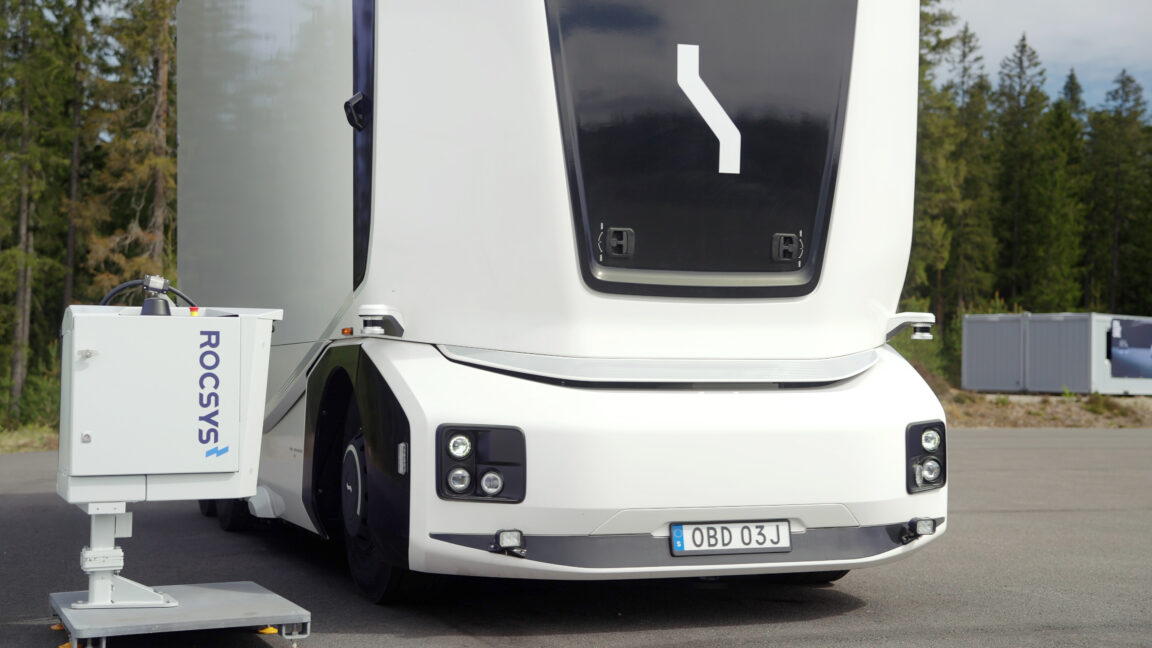
This first joining of a Rocsys robotic steward and an Einride AET took place at the AstaZero proving ground in Sandhult, Sweden, an automation test facility that has been a safe playground for driverless vehicles of all shapes and sizes for over a decade.
This physical connection between Rocsys and Einride is a small step, with one automated charger connected to one automated truck, compared to the nearly 3 million diesel-powered semis droning around our highways in the United States alone. But you have to start somewhere, and while bringing this technology to more open roads is the goal, closed logistics centers and ports are a great first step.
“The use case is simpler,” Bouman said. “There are no cats and dogs jumping, or children, or people on bicycles.”
And how complicated was it to connect Einride’s systems to those of the Rocsys robotic steward? Green said the software integration with the Rocsys system was straightforward but that “some adaptations” were required to make Einride’s machine compatible. “We had to make a ‘duct tape solution’ for this particular demo,” Green said.
Applying duct tape, at least, seems like a safe job for humans for some time to come.
[ad_2]
Source link


