
[ad_1]
To encode messages, the researchers assigned different bubble sizes, shapes, and orientations to Morse code and binary characters and used their freezing method to produce ice bubbles representing the desired characters. Next, they took a photograph of the ice layer and converted it to gray scale, training a computer to identify the position and the size of the bubbles and decode the message into English letters and Arabic numerals. The team found that binary coding could store messages 10 times longer than Morse code.
Someday, this freezing method could be used for short message storage in Antarctica and similar very cold regions where traditional information storage methods are difficult and/or too costly, per the authors. However, Qiang Tang of the University of Australia, who was not involved in the research, told New Scientist that he did not see much practical application for the breakthrough in cryptography or security, “unless a polar bear may want to tell someone something.”
Cell Physical Science, 2025. DOI: 10.1016/j.xcrp.2025.102622 (About DOIs).
Cats prefer to sleep on left side
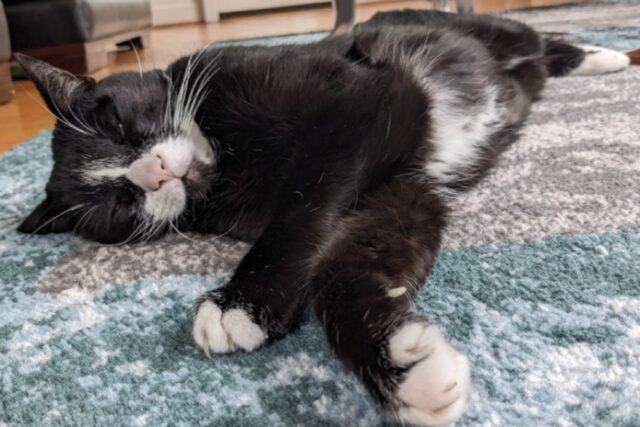
Caliban marches to his own drum and prefers to nap on his right side.
Credit:
Sean Carroll
The Internet was made for cats, especially YouTube, which features millions of videos of varying quality, documenting the crazy antics of our furry feline friends. Those videos can also serve the interests of science, as evidenced by the international team of researchers who analyzed 408 publicly available videos of sleeping cats to study whether the kitties showed any preference for sleeping on their right or left sides. According to a paper published in the journal Current Biology, two-thirds of those videos showed cats sleeping on their left sides.
Why should this behavioral asymmetry be the case? There are likely various reasons, but the authors hypothesize that it has something to do with kitty perception and their vulnerability to predators while asleep (usually between 12 to 16 hours a day). The right hemisphere of the brain dominates in spatial attention, while the right amygdala is dominant for processing threats. That’s why most species react more quickly when a predator approaches from the left. Because a cat’s left visual field is processed in the dominant right hemisphere of their brains, “sleeping on the left side can therefore be a survival strategy,” the authors concluded.
[ad_2]
Source link


