
[ad_1]

In a new study, researchers from the University of Tokyo, Harvard University, and the International Research Center for Neurointelligence have unveiled a technique for creating lifelike robotic skin using living human cells. As a proof of concept, the team engineered a small robotic face capable of smiling, covered entirely with a layer of pink living tissue.
The researchers note that using living skin tissue as a robot covering has benefits, as it’s flexible enough to convey emotions and can potentially repair itself. “As the role of robots continues to evolve, the materials used to cover social robots need to exhibit lifelike functions, such as self-healing,” wrote the researchers in the study.
Shoji Takeuchi, Michio Kawai, Minghao Nie, and Haruka Oda authored the study, titled “Perforation-type anchors inspired by skin ligament for robotic face covered with living skin,” which is due for July publication in Cell Reports Physical Science. We learned of the study from a report published earlier this week by New Scientist.
The study describes a novel method for attaching cultured skin to robotic surfaces using “perforation-type anchors” inspired by natural skin ligaments. These tiny v-shaped cavities in the robot’s structure allow living tissue to infiltrate and create a secure bond, mimicking how human skin attaches to underlying tissues.
To demonstrate the skin’s capabilities, the team engineered a palm-sized robotic face able to form a convincing smile. Actuators connected to the base allowed the face to move, with the living skin flexing. The researchers also covered a static 3D-printed head shape with the engineered skin.
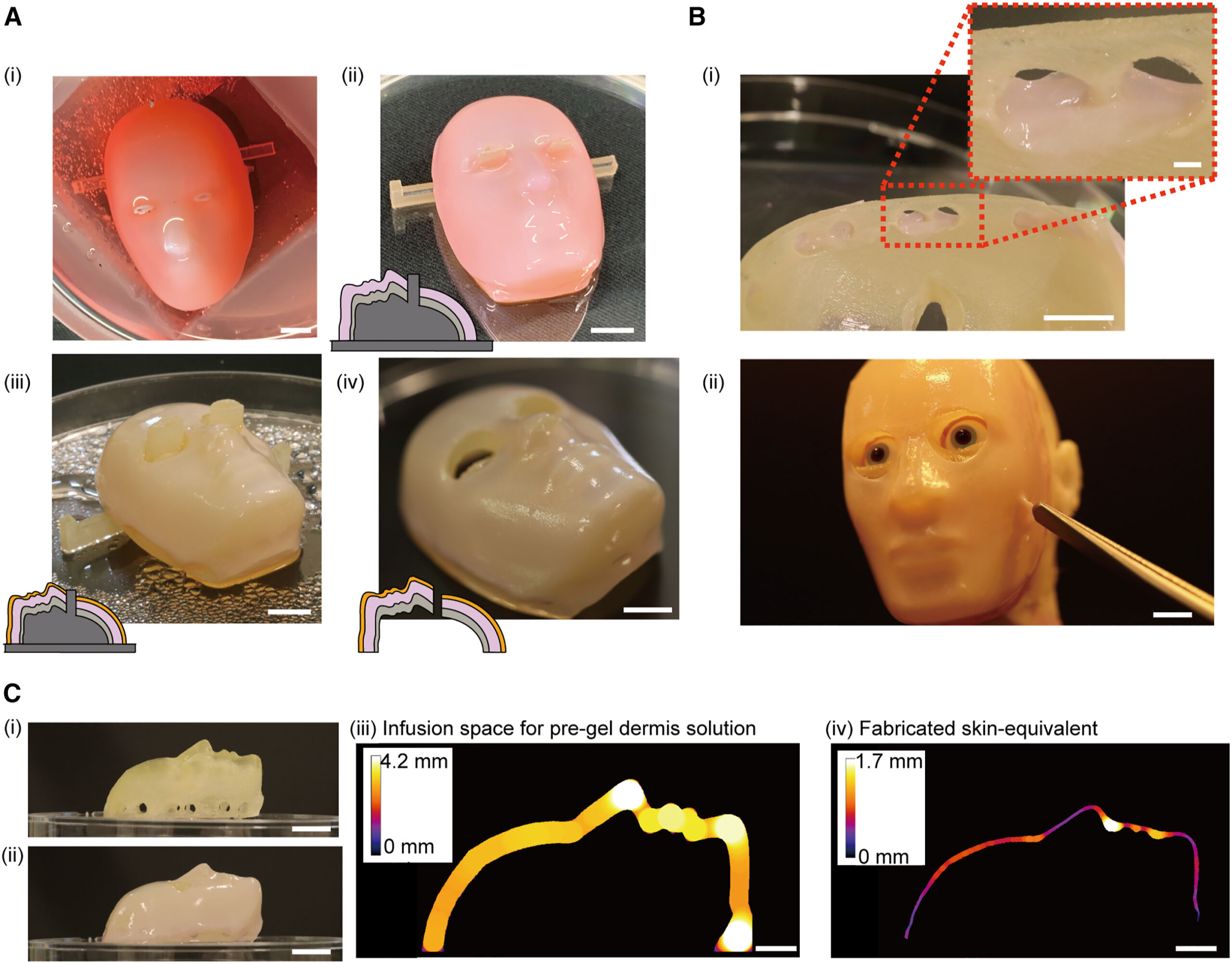
Takeuchi et al. created their robotic face by first 3D-printing a resin base embedded with the perforation-type anchors. They then applied a mixture of human skin cells in a collagen scaffold, allowing the living tissue to grow into the anchors.
[ad_2]
Source link


