
[ad_1]
The global land area affected by drought has doubled in the last 120 years. The cost of droughts has also risen sharply. An average drought in 2035 is projected to cost at least 35% more than it would today, according to a new OECD report.
The OECD Global Drought Outlook: Trends, Impacts and Policies to Adapt to a Drier World finds that climate change is driving the severity of droughts, with 40% of the planet having experienced more frequent and intense droughts in recent decades.
Immediate and co-ordinated action across government agencies to anticipate, prevent, and adapt to evolving drought risk could help limit losses and damage, while enhancing the ability of communities and economies to withstand and recover from drought.
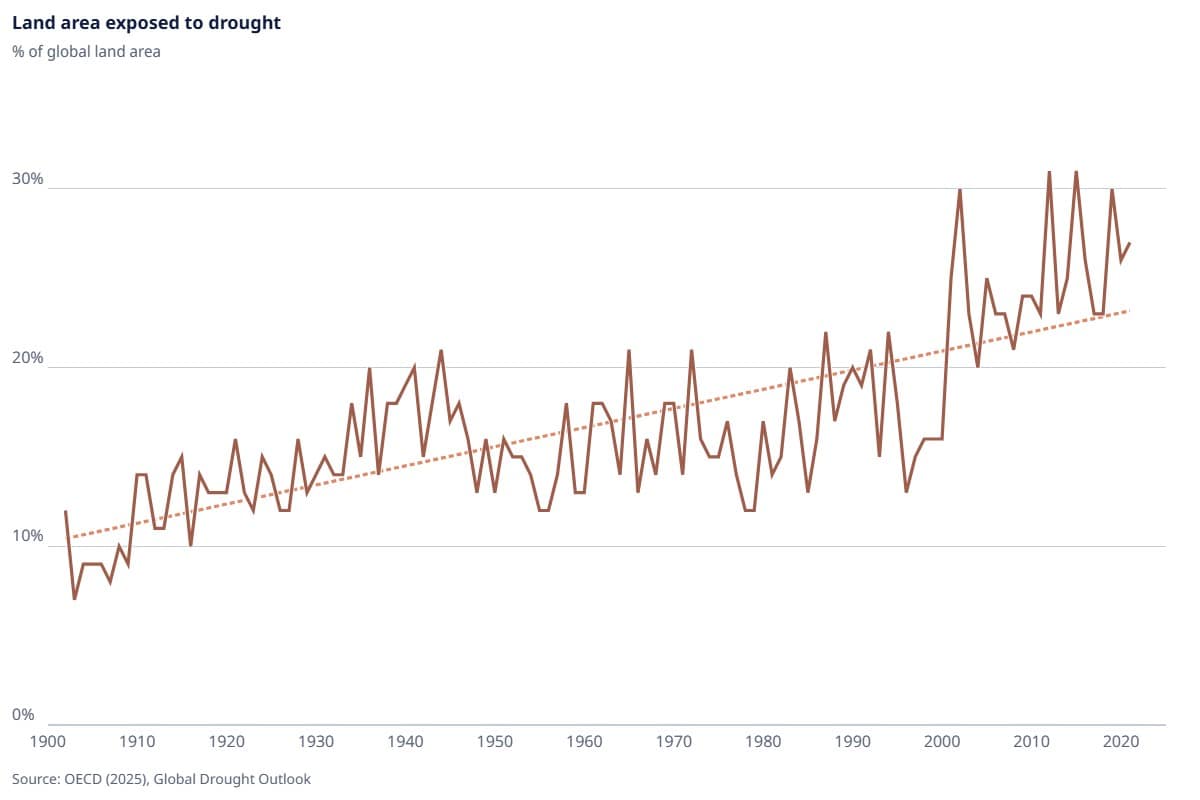
Droughts cause productivity losses far beyond agriculture, affecting trade, industry and energy production. OECD analysis of the observed and projected trends in drought occurrence shows the scale of not just the economic, but also the environmental and social consequences. Since 1980, 37% of global land has experienced significant soil moisture loss. In addition, 62% of monitored aquifers supplying over 75% of global withdrawals show declining groundwater levels since 2000. The human toll of drought is equally stark, with droughts contributing to disaster-related deaths and exacerbating poverty, inequality, and displacement.
“Co-ordinated policy action across levels of government, sectors and countries is needed to respond to growing drought risks and mitigate impacts on food security, health, energy, transport, agriculture, peace and security,” OECD Secretary-General Mathias Cormann said.
“Practical solutions to sustainably manage water, ecosystems and land can reduce vulnerability, enhance preparedness and mitigate the economic impacts of droughts.”
The Outlook highlights that a proactive adaptation approach would not only mitigate the negative effects of drought on communities but also enhance economic resilience and performance. It identifies the underlying drivers and impacts of drought and analyses how selected policies and measures can enhance resilience and support adaptation in a drier world.
Wider adoption of existing solutions is needed to achieve system-wide impact. Innovations in water use, including through water recycling and harvesting, can significantly reduce water abstraction by industry and manufacturing. The cultivation of drought tolerant crops can be advanced through incentives and alignment of regulatory measures, and more efficient irrigation systems could significantly reduce global water use. Sustainable land use and ecosystem management also play a critical role in strengthening natural resilience to drought and safeguarding essential water-related ecosystem services.
[ad_2]
Source link


