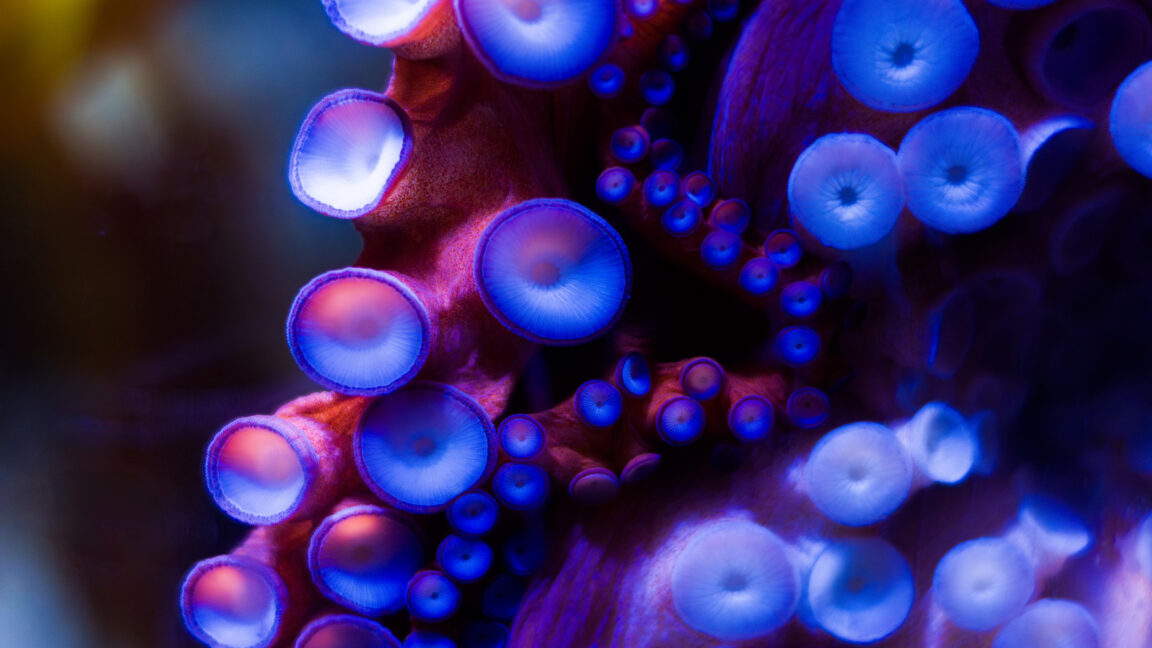
This isn’t the first time suction cups were inspired by highly adaptive octopus suckers. Some models have used pressurized chambers meant to push against a surface and conform to it. Others have focused more on matching the morphology of a biological sucker. This has included giving the suckers microdenticles, the tiny tooth-like projections on octopus suckers that give them a stronger grip.
Previous methods of artificial conformation have had some success, but they could be prone to leakage from gaps between the sucker and the surface it is trying to stick to, and they often needed vacuum pumps to operate. Yue and his team created a sucker that was morphologically and mechanically similar to that of an octopus.
Suckers are muscular structures with an extreme flexibility that helps them conform to objects without leakage, contract when gripping objects, and release tension when letting them go. This inspired the researchers to create suckers from a silicone sponge material on the inside and a soft silicone pad on the outside.
For the ultimate biomimicry, Yue thought that the answer to the problems experienced with previous models was to come up with a sucker that simulated the mucus secretion of octopus suckers.
This really sucks
Cephalopod suction was previously thought to be a product of these creatures’ soft, flexible bodies, which can deform easily to adapt to whatever surface it needs to grip. Mucus secretion was mostly overlooked until Yue decided to incorporate it into his robo-suckers.
Mollusk mucus is known to be five times more viscous than water. For Yue’s suckers, an artificial fluidic system, designed to mimic the secretions released by glands on a biological sucker, creates a liquid seal between the sucker and the surface it is adhering to, just about eliminating gaps. It might not have the strength of octopus slime, but water is the next best option for a robot that is going to be immersed in water when it goes exploring, possibly in underwater caves or at the bottom of the ocean.


