Russia’s war in Ukraine continues to slip from the front pages of mainstream media, even as it enters another grim phase of escalation.
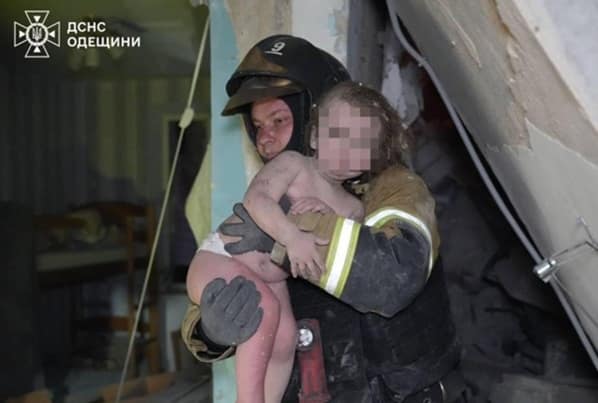
Last night, fresh strikes hit Odesa, killing at least three civilians, including a child, and injuring ten more, among them a two-year-old and teenagers, with several in critical condition.
Residential buildings and civilian infrastructure were deliberately targeted, reducing homes to rubble, destroying entire floors of apartment blocks, and trapping people beneath them as rescue teams worked through the night.
This is no longer incidental or collateral. Russia has targeted civilians since the earliest days of the invasion, Bucha, Mariupol, and Bakhmut stand as stark reminders.
But this latest escalation underscores a pattern that is becoming impossible to ignore: Vladimir Putin is intensifying a campaign of terror, largely because it is going insufficiently challenged.
A recycled Soviet playbook, a failed winter campaign, and stalled frontlines all point to a Kremlin running out of options, and increasingly, out of ideas.
Russia has killed three civilians in Odesa, including a child through the night.
Ten more people were injured, among them a two-year-old and two teenagers.
Overnight, Russian strikes hit a residential building, destroying multiple floors. People may still be trapped under the… pic.twitter.com/laKS32EBGR
— Shaun Pinner (@ShaunPinnerUA) April 6, 2026
The latest bombardment saw multi-storey buildings struck, with entire sections reduced to rubble. Emergency services worked through the night, pulling survivors from beneath collapsed floors while others remain unaccounted for. These are not isolated incidents or battlefield errors; they are part of a deliberate shift, one that prioritises psychological pressure over military gain, targeting Ukrainians at the very core of daily life.
In yesterday’s analysis, I wrote about the evolving trajectory of the war and how Ukraine, despite immense strain, is stabilising key sections of the frontline. That fragile advantage now appears to be provoking a response from Moscow. Unable to achieve decisive breakthroughs on the battlefield, Russia is doubling down on what it can still influence: civilian suffering.
Ukraine has quietly regained the initiative and the war is shifting
The contrast between regions inside Ukraine is telling. Here in Dnipro, the relative quiet over recent days has been noticeable, but that silence is deceptive. Experience tells me it is not a sign of safety; it is a pause. In this war, quiet cities are often simply waiting their turn. The rhythm of Russian strikes has become erratic, yet predictable in intent: no place remains untouched indefinitely.
At the same time, Ukraine continues to demonstrate its growing reach. In a coordinated drone campaign yesterday evening, Ukrainian forces struck deep into Russian-controlled infrastructure. Targets included refineries, critical energy assets, and port facilities in Novorossiysk. The strike on the Sheskharis Oil Terminal, an important node in Russia’s export and logistics network, signals Kyiv’s increasing ability to disrupt the economic backbone of the war.
Yet, ironically, this has led to calls for Ukraine to ease such strikes, rather than calls for Russia to stop bombing civilians. Where is the international outcry?
The effects were not confined to Russian territory. Reports indicate power disruptions across occupied regions, including Mariupol, a city already devastated by earlier phases of the invasion. These strikes serve a dual purpose: degrading Russia’s war economy while demonstrating that occupation does not equate to control, in other words, offering a measure of hope to the estimated six million Ukrainians living under occupation, “we are still here”.
This dynamic, Russia targeting civilians while Ukraine targets infrastructure, highlights a widening asymmetry in approach. One side seeks to break morale through fear; the other aims to dismantle the systems sustaining the war. Yet the danger lies in escalation as Ukraine’s long-range capabilities improve, Russia’s response has become increasingly indiscriminate. The more pressure Moscow feels, the more it appears willing to lash out at civilian populations. Odesa is simply the latest example.
What we are witnessing is not a war entering its final phase, but one still evolving in real time. Russia’s inability to achieve strategic success on the battlefield is pushing it toward more extreme measures, terrorism by any other name. Ukraine, meanwhile, is proving it can strike back in ways that matter, not just tactically, but economically and psychologically.
The question now is not whether this pattern will continue, but how far it will go.
From here in Ukraine, the trajectory is clear: pressure is building on both sides, but as history has shown time and again, that pressure rarely favours the aggressor.


